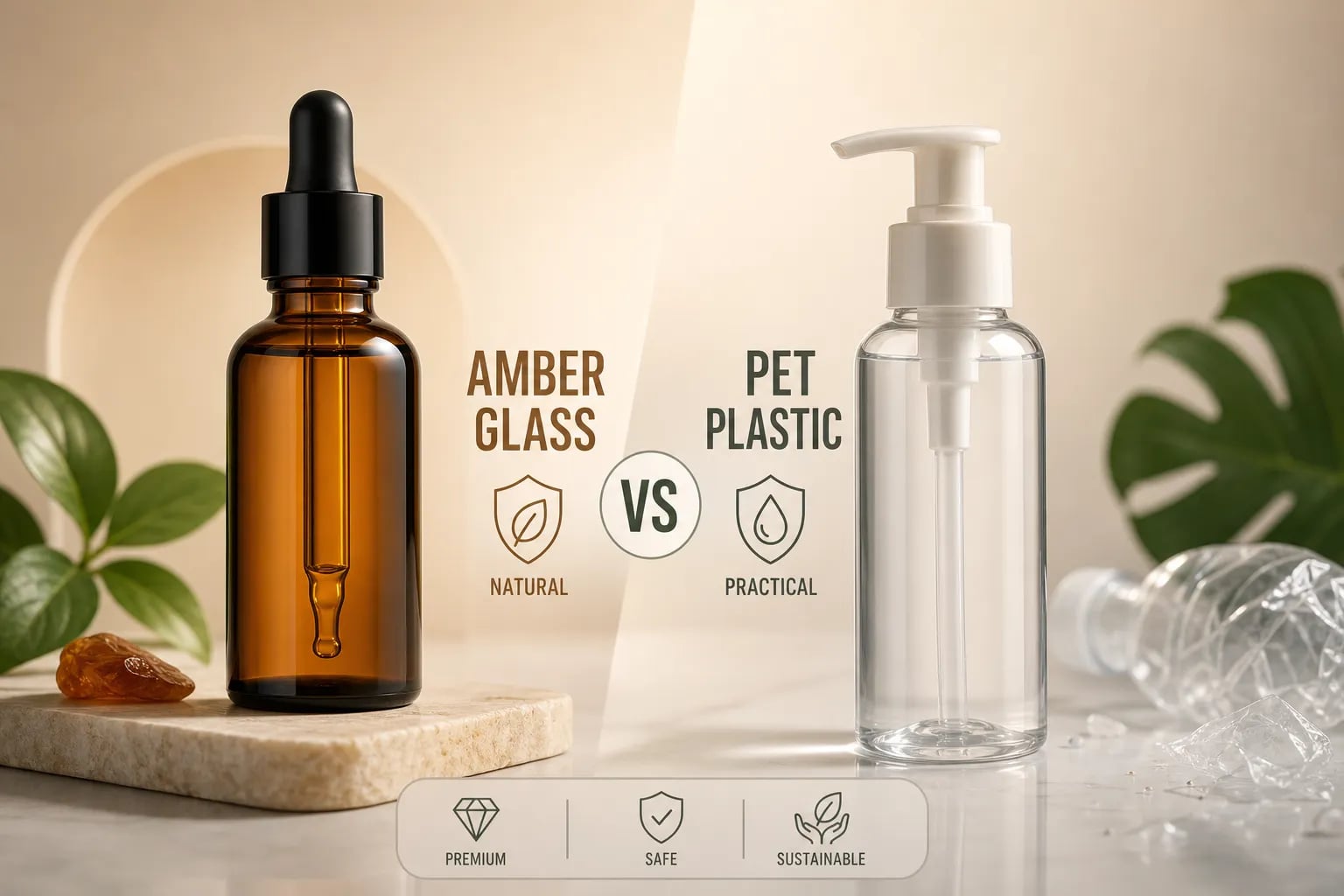
Amber glass vs PET plastic: amber glass wins on UV protection, chemical inertness, and premium shelf appeal. PET plastic wins on cost, weight, and shatter resistance. Neither material is universally better, the right container depends entirely on what’s inside the bottle and how you’re getting it to your customer.
The comparison breaks down across five practical axes: light protection, barrier performance, chemical safety, cost, and sustainability. Work through each of those for your specific formula and the answer becomes clear. A recommended best practice is to run side-by-side stability tests with both materials before committing to one, and suppliers like BOBOPKG make this easy with low-MOQ wholesale options on both amber glass bottles and PET plastic containers. That way, you’re not locked into a full production run before you’ve seen the results.
Key takeaways
- UV protection reliability: Amber glass blocks approximately 95–99% of UV-B/C out of the box; amber PET performance varies by pigment and additives and must be confirmed with spectral data.
- Barrier performance: Glass is effectively impermeable to oxygen; standard PET allows measurable oxygen diffusion that shortens shelf life for oxidation-prone actives.
- Chemical safety: Amber glass is more inert for reactive, oil-rich, and solvent-heavy formulas; standard PET is acceptable for water-based products with no aggressive solvents.
- Cost and weight: PET is typically 30–60% cheaper per unit and significantly lighter, which reduces shipping costs substantially for DTC brands.
- Sustainability: rPET generally carries a lower carbon footprint than single-use glass; glass gains the advantage only when bottles are genuinely reused multiple times.
- Formula-first decision: Match the material to what’s inside the container, not to aesthetic preference alone.
What actually makes amber glass and PET plastic different?
The basic chemistry of each material
Amber glass gets its color from iron, sulfur, and carbon oxides fused at high temperature. That chemistry is exactly what gives it UV absorption built into the glass matrix itself: the colorants are part of the glass structure, not a surface coating that can wear or degrade. PET, short for polyethylene terephthalate, is a lightweight polymer produced through polycondensation. It’s clear by default, and any amber color or UV-blocking performance depends entirely on added pigments or UV-absorbing additives, not its base composition.
This distinction matters far more than it sounds. When UV protection is built into the glass at a molecular level, the performance is consistent and predictable across every bottle in a run. When UV performance depends on additive concentration and pigment loading in PET, that performance is variable and needs to be verified with actual spectral data before you rely on it for a photosensitive formula.
Why the starting material shapes everything downstream
Glass is inorganic and non-porous. That structure makes it chemically stable and essentially impermeable to gases, moisture, and volatile compounds. PET is a polymer with a molecular structure that allows small molecules, including oxygen, water vapor, and aroma compounds, to slowly diffuse through the wall over time. This single structural difference explains the downstream gaps in barrier performance, migration risk, and shelf life that the rest of this article covers.
How well does amber glass protect formulas from UV light?
The UV-blocking numbers, broken down by material
Clear glass transmits roughly 80–90% of UV-A and visible light, offering almost no inherent protection for light-sensitive formulas. Standard amber glass blocks approximately 95–99% of UV-B/C and most UV-A, though it still transmits around 20–30% of high-energy blue light in the 400–450 nm range. For most light-sensitive cosmetic formulas, that level of protection is strong enough to extend shelf life meaningfully compared to clear packaging.
Clear PET behaves similarly to clear glass unless UV absorbers are added. Amber or UV-stabilized PET can approach amber glass performance, but that depends entirely on pigment concentration, the specific additives used, and wall thickness. Color alone is not a reliable guarantee of UV protection with PET containers.
When UV protection genuinely changes your formula’s shelf life
The formulas where UV exposure causes real, measurable degradation include essential oils, vitamin C serums, retinol products, botanical extracts, and fragrance oils. For these, amber glass bottles are the stronger and more reliable default choice because the protection is built in. For water-based toners, creams, or cleansers with no light-reactive actives, the UV protection gap between amber glass versus PET plastic narrows considerably, and either can work depending on other factors.
What “amber PET” actually means and why you should verify it
A common sourcing mistake is buying amber-colored PET and assuming it matches amber glass UV performance without any supporting data. Published packaging comparisons report roughly 30–50% UVA transmission for some UV-blocking PET formulations, while well-designed formulations with the right additive package can perform substantially better. Before you commit amber PET to a formula making shelf-life claims, ask your supplier for spectral transmission data for the actual bottle wall thickness. The measured curve matters far more than the color.
Which material creates a stronger barrier for sensitive ingredients?
Oxygen transmission: where the gap between glass and PET shows up clearly
Glass is effectively impermeable to oxygen. A standard-gauge PET cosmetic bottle typically transmits about 0.05–0.3 cc of oxygen per bottle per day at room temperature, while comparable glass packaging allows roughly less than 0.001 cc per day, based on published barrier-property measurements for pharmaceutical and cosmetic containers. That means PET may allow approximately 50–300 times more oxygen ingress than glass, depending on bottle size, wall thickness, and closure. For oxidation-prone formulas, including serums with antioxidants, carrier oil blends with unsaturated fatty acids, and vitamin-rich actives, that gap translates directly to shorter shelf life or a higher preservative load.
One bottle study recorded a water-vapor transmission rate (g/m²/day) of approximately 0.07 for glass versus 9.9 for PET, as reported in Barrier Properties of Pharma Bottles. That magnitude of difference matters for water-sensitive formulations, dehydrated powders, and anything where moisture exchange at the container wall affects product performance.
Moisture and aroma retention across formula types
Glass holds in volatile aroma compounds and prevents moisture exchange at the container wall, as documented in packaging barrier-property studies comparing glass and polymer containers. PET is more prone to sorption, which means the polymer can absorb fragrance compounds from the product, and aroma loss is more noticeable with terpene-rich or high-fragrance formulas. For concentrated facial oils, botanical tinctures, and solid or liquid perfumes, the glass barrier advantage is real. For shampoos, body washes, and most water-heavy lotions, standard PET provides acceptable moisture and oxygen protection for typical shelf-life windows.
Where closures and seals matter more than the container itself
Barrier performance is a system, not just a bottle. The cap, liner, and seal can be the weakest link in both glass and PET setups regardless of how well the container itself performs. Specifying a quality closure and induction seal matters as much as the bottle material for truly oxygen-sensitive formulas. No container study replaces a full package validation using the actual closure and fill volume before you launch.
Are there real safety concerns when using PET with cosmetic formulas?
What can migrate from PET into the formula and under what conditions
PET can release trace oligomers, antimony catalyst residues, UV stabilizer compounds like Tinuvin P and Tinuvin 234, antioxidant-degradation products, and other non-intentionally added substances, as documented in peer-reviewed migration studies and systematic reviews of polymer-cosmetic interactions. Migration generally increases with heat, long storage, aggressive solvents, high oil content, and larger surface-area-to-volume ratios. The common claim that PET universally leaches phthalates is misleading: PET itself does not require phthalate plasticizers, though phthalates or other chemicals can enter from closures, labels, inks, recycled content, or contaminated manufacturing streams.
Which cosmetic formulas are most at risk with standard PET
The highest-concern categories for PET compatibility are essential oil blends and terpene-heavy products, high-concentration alcohol-based formulas, oily formulations including carrier oil serums, and products stored in warm environments. These can cause polymer swelling, stress cracking, ingredient sorption, or accelerated migration of additives into the formula. PET is well-suited for water-based cleansers, toners, shampoos, and body lotions with standard preservative systems and no aggressive solvents.
Why glass is not perfectly inert either and what to test
Glass can release trace alkali or mineral ions into poorly buffered formulas, especially with Type II or Type III glass rather than pharmaceutical-grade Type I. Neither material eliminates the need for a container-closure compatibility study using the actual formula, storage conditions, and fill volume before launch. The relevant evidence for a final packaging decision is not the resin or glass type alone: it’s a compatibility and extractables study run under real conditions.
What does amber glass actually cost compared to PET?
Unit price, shipping weight, and breakage: the full landed-cost picture
PET generally saves 30–60% at the unit level. But unit price is only part of the story. A 30 ml amber glass bottle can weigh roughly 212 grams packaged versus 59 grams for PET, according to packfolio.com, and that difference compounds across a full shipment. Glass also requires protective inserts and cartons that PET doesn’t need, and industry breakage allowances of 1–3% add replacement and returns costs that rarely appear on a packaging invoice.
How freight and parcel shipping costs shift the comparison
Glass-packaged products can cost 15–40% more to ship direct-to-consumer because of weight, dimensional sizing, and protective packaging requirements, according to packfolio.com. For DTC beauty brands fulfilling individual orders, that freight premium can erode margins faster than the bottle price difference alone. PET’s lighter weight means more units per pallet, simpler packaging, and near-zero breakage during distribution, which matters a lot when you’re shipping dozens of small orders per week.
Tooling and volume effects for small brands
At small quantities using stock molds, the tooling difference largely disappears and the comparison becomes unit price plus freight. Custom glass molds can require up to $50,000 with MOQs of around 10,000 units, according to packfolio.com, making custom glass packaging cost-prohibitive at early brand stages. For small brands testing new SKUs, standard stock amber glass bottles and PET containers are the practical starting point. Custom molds, in either material, are a conversation for proven sellers with stable design specs.
Which material is more sustainable in the long run?
Carbon footprint and energy use over the product’s life
Life-cycle analyses generally find that PET and especially rPET have a lower carbon footprint per delivered bottle than single-use glass. In one comparative LCA published in MDPI, the rPET system emitted 459–634 kg CO2e versus 790–1,137 kg for glass, roughly 40% lower. The main driver is weight: glass requires energy-intensive furnace melting above approximately 1,500 degrees Celsius, and heavier containers produce more emissions in transport. Recycled glass (cullet) helps, cutting roughly 2–3% CO2 for each additional 10% cullet content, but glass can still remain higher-impact than lightweight rPET because it must be remelted at high temperature and stays heavy regardless of recycled content.
Recyclability in practice, not just in principle
Glass is technically infinitely recyclable without material degradation, with reported collection rates that can exceed 75%. But amber glass complicates the picture: color-sorted recycling streams are needed to maintain quality, and mixed-color cullet often gets downgraded to lower-value applications, meaning the closed-loop recycling rate for amber glass can be lower than its collection rate where color-separated recovery is weak. PET is widely collected, but roughly one-third of PET feedstock is lost during mechanical recycling, according to material-flow analyses cited by Resource Recycling. rPET offers a meaningful improvement: one estimate, based on data from eprints.whiterose.ac.uk, puts virgin PET at 4.03 kg CO2e per kilogram versus 3.13 kg for rPET.
The honest takeaway for indie brands
For a single-use cosmetic bottle, rPET typically wins on total environmental impact. Glass wins when bottles are genuinely reused multiple times in a local refill system, because the manufacturing impact is spread across multiple uses. Neither material has a clean sustainability story without factoring in collection infrastructure, actual recycling yields, and distribution distances. Choosing recycled content in either material is the most direct lever a small brand can pull, and specifying rPET containers gives you a credible, LCA-backed sustainability claim rather than a vague packaging promise.
Amber glass vs PET plastic: a side-by-side comparison
Use this table as a decision-starting framework. The “winner” in each row depends on your formula and business model; no single row drives the whole answer.
| Comparison factor | Amber glass | PET plastic |
|---|---|---|
| UV and light protection | Blocks approximately 95–99% of UV-B/C; reliable and consistent out of the box | Variable; depends on pigment and UV additives; must be verified with spectral transmission data |
| Oxygen and moisture barrier | Excellent; effectively impermeable to oxygen and water vapor | Good for most formulas; measurable oxygen diffusion limits suitability for highly oxidation-sensitive actives |
| Chemical safety and migration | Low organic extractables; more inert for reactive, oil-rich, or solvent-heavy formulas | Acceptable for water-based formulas; risk increases with oils, solvents, heat, and long storage |
| Unit cost and landed cost | Higher unit cost; heavier freight; protective packaging required; 1–3% breakage allowance | Lower unit cost; lighter shipping; near-zero breakage; simpler fulfillment packaging |
| Sustainability | High collection rate; heavier carbon footprint per single-use bottle; color sorting required for quality recycling | Lower carbon footprint; rPET cuts further; mechanical recycling yields vary by region |
| Best formula fit | Essential oils, vitamin C serums, retinol, botanical extracts, fragrance oils, light-reactive actives | Shampoos, body wash, toners, cleansers, standard lotions, water-based formulas |
How to read this table for your specific product
Most brands don’t face a pure binary choice across their entire line. A brand with five SKUs might rationally use amber glass for a vitamin C serum and PET for a foaming cleanser, and that’s the right call if the formula performance data and landed-cost math support it. The table is a starting framework; a container-closure compatibility study and a full landed-cost calculation for your specific formula, distribution channel, and order volume drive the final decision.
Which bottle is actually right for your formula?
When amber glass bottles are the better choice
Amber glass is the stronger choice for essential oil blends, vitamin-rich serums with ascorbic acid or retinol, botanical extracts, perfume oils, and fragrance-forward products where both UV protection and aroma retention matter. It’s also the right call when premium shelf presentation is non-negotiable: the weight and visual gravitas of glass communicates quality in a way that standard-wall PET hasn’t replicated. If your brand competes on perceived luxury and your retail price supports the packaging cost, the amber glass premium is an investment in brand positioning as much as formula protection.
When PET containers make more sense
PET is the smarter choice for water-based formulas, including toners, shampoos, cleansers, and body lotions, where the barrier gap between glass and PET doesn’t translate to a meaningful shelf-life difference. It’s also the practical choice for direct-to-consumer or e-commerce brands where shipping weight directly impacts per-order cost, and for early-stage brands managing cash flow carefully across multiple SKUs. Travel-size and sample products are another clear PET win: the breakage risk during transit is real with glass, and the cost of a broken sample reaching a potential customer is higher than the unit price difference.
Amber glass vs PET plastic: when to test both before you scale
The smartest move for a new SKU is to run a small compatibility test with your actual formula in both materials before locking in a packaging decision. Fill a set of amber glass bottles and a set of amber PET bottles with your product, store them under your expected conditions, and evaluate stability, aroma retention, and appearance at 4, 8, and 12 weeks. At the same time, calculate your real landed cost per unit, including freight, protective packaging, and breakage allowance, not just the bottle price from the invoice.
We stock both amber glass bottles and PET plastic containers at BOBOPKG with low MOQs, so you can order meaningful test quantities of either material without a large upfront commitment. That means your packaging decision is based on actual formula data and real cost numbers, not assumptions made from a spec sheet. Browse our catalog to find the sizes and formats that fit your current SKUs, and reach out to our team if you need guidance on which options work best for a specific formula type.
Making the right call for your formula and your brand
Amber glass vs PET plastic is not a question with a universal winner. Glass is the more reliable choice when UV protection, barrier strength, and chemical inertness are critical to your formula’s stability and shelf life. PET is more practical when cost, weight, and shatter resistance matter more than absolute protection, particularly for water-based formulas shipped direct to consumer.
The smartest packaging decisions come from testing both materials with the actual formula, reviewing compatibility data, and calculating the full landed cost including freight and breakage, not just the per-bottle price. Equally, the premium for amber glass can be fully justified when it’s the only container that keeps your formula stable for 24 months on a retail shelf.
At BOBOPKG, we give small brands the flexibility to make that call based on real data rather than assumptions. With 3,000-plus SKUs and low-MOQ ordering on both amber glass and PET containers, you don’t need a factory-scale commitment to run a proper packaging evaluation. Get in touch with our team to discuss your formula type and find the right starting point for your next SKU.
Frequently Asked Questions
How long should we run stability tests when comparing amber glass and PET for a new formula?
We recommend running stability evaluations at 4, 8, and 12 weeks with your actual formula in both materials. Those checkpoints let you compare stability, aroma retention, and appearance under expected storage conditions before scaling up.
How should we verify that an amber PET bottle actually blocks UV like amber glass does?
We advise you to ask the supplier for spectral transmission data for the actual bottle wall thickness because PET UV performance depends on pigment concentration and additives. Measured spectral curves matter far more than color alone before you rely on amber PET for photosensitive formulas.
Do closures and seals matter when we pick between amber glass and PET?
Yes, closures and seals matter as much as the bottle material because barrier performance is a system, not just a container. Specifying a quality closure and running a full package validation with the actual closure and fill volume is essential for oxygen-sensitive formulas.