Amber glass skincare packaging blocks over 99% of UVB radiation and reduces UVA transmission to as little as 1–8%, making it an effective passive photoprotection option for many light-sensitive formulas, though opaque or airless systems can outperform it for the most unstable actives. For moderately light-sensitive products, amber glass often reduces the need for an outer carton and rarely requires formula reformulation. For the formulas that genuinely need UV protection, the wrong container can destroy potency before the customer ever opens the bottle. If you’re sourcing amber glass bottles and need a supplier that works with indie-sized orders, BOBOPKG stocks a full range of amber glass skincare containers, from small 5 ml dropper bottles to larger pump and spray configurations, with low MOQ options built for brands ordering in the 50–500 unit range.
Key takeaways
- UV blocking performance: Standard amber glass transmits less than 1% of UVB and as little as 1–8% of UVA, compared to 75–90% transmission through clear glass in the same wavelength ranges.
- Top formulas to protect: Retinol, retinaldehyde, L-ascorbic acid (vitamin C), essential oils, and botanical extracts rich in polyphenols or carotenoids benefit most from amber glass containers.
- Amber glass has limits: It reduces light-driven degradation but does not stop oxidation, heat damage, or pH-related breakdown. It works best paired with tight closures and minimal headspace.
- Container format matters: Dropper bottles, pump bottles, cream jars, and roll-ons are all available in amber glass; the right format depends on formula viscosity and dispensing needs.
- Low MOQ access exists: Indie brands don’t need factory-scale minimums to access quality amber glass packaging. Suppliers like BOBOPKG offer stock amber glass with flexible low-lot purchasing.
- Test before you commit: Always run formula compatibility tests with the full assembled system (bottle, closure, pipette or dip tube) before placing a full order.
How much UV light does amber glass actually block?
Most people assume amber glass simply “helps with light,” but the actual transmission figures tell a more precise story. The wavelength bands that matter most for skincare formulas are UVB (290–320 nm), UVA (320–400 nm), and the blue-violet visible range (400–450 nm). Clear glass is effectively transparent across the most damaging portion of that spectrum, while amber glass cuts transmission dramatically across all three bands.
The wavelength breakdown: amber vs. clear glass
Standard amber glass transmits less than 1% of UVB light, compared to 75–85% transmission through clear glass in the same range. UVA transmission through amber glass sits between 1–8%, while clear glass transmits 85–90% of that same UVA band. In the blue-violet visible range (400–450 nm), amber glass still blocks 80–90%, while clear glass lets nearly all of it through. Put plainly: clear glass provides almost no UV barrier for the wavelengths that most aggressively degrade active skincare ingredients.
What amber glass still lets through
Amber glass is not opaque, and it’s worth being honest about that. Above 450 nm, it transmits increasing amounts of yellow, orange, and red visible light, which is why the formula inside remains faintly visible through the glass. For products where even visible light exposure is a concern, such as highly unstable retinoid formulations, some brands pair amber glass with an outer carton or opaque label wrap to close that gap.
Why thickness and amber depth change performance
Not all amber glass performs equally. Measured bottle spectral data, which vary by wall thickness and glass formulation, show light amber glass transmitting roughly 1–2% of UV-violet light in the 320–440 nm range, while dark pharmaceutical-grade amber transmits below 0.3% across the same band. A thin, pale amber bottle can perform noticeably worse than thick, dark amber glass even if both look similar on a shelf. Brands should request UV transmission specs for the specific bottle model from their supplier, and note that those figures depend on the exact SKU’s wall thickness, rather than trusting color by eye alone.
Which skincare formulas genuinely need amber glass packaging?
Not every formula is equally light-sensitive. Some ingredients hold up well in clear glass; others degrade visibly within weeks of UV exposure. Understanding which actives carry the highest photosensitivity risk helps brands make an informed decision about when amber glass is a genuine investment and when it’s optional.
Retinol and retinaldehyde: the highest-risk actives
Retinoids sit at the top of the photosensitivity scale. UV and visible light accelerate both photodegradation and oxidation, reducing efficacy before the product reaches the consumer. The most sensitive retinoid products often benefit from opaque or airless packaging in addition to colored glass.
Vitamin C serums and botanical extracts
L-ascorbic acid (pure vitamin C) is highly sensitive to light, oxygen, and heat simultaneously. Amber glass packaging for serums addresses the light variable effectively. Amber glass does not stop oxidation from repeated air exposure, so it works best when paired with a dropper or pump closure that limits headspace. Many botanical extracts containing polyphenols, carotenoids, and anthocyanins share similar vulnerability to UV-driven breakdown.
Essential oils and facial oil blends
Citrus-based oils and oils rich in unsaturated compounds, including rosehip, argan, and sea buckthorn, are particularly prone to photo-oxidation, which changes both aroma and skin-active properties. Amber glass dropper bottles are a standard and practical solution for these formulas. Lavender, tea tree, and other common essential oils used in wellness blends benefit from the same UV protection, especially when sold in packaging that may sit on a retail shelf under store lighting for weeks at a time.
What doesn’t urgently need amber glass
Glycerin, hyaluronic acid, and stable forms of niacinamide generally don’t require amber glass for light protection alone. Simple, well-preserved toners or body washes with stable preservative systems can often perform well in clear glass or quality PET. Saving amber glass for the formulas that genuinely need it also keeps packaging costs focused where they deliver real product-stability value.
Does amber glass actually extend shelf life?
This is the right question to ask before committing to a packaging format. For formulas where photodegradation is the dominant failure mode, the short answer is yes. The fuller answer requires some context about what amber glass can and cannot do on its own, and why that distinction matters for brand decision-making.
When amber glass isn’t enough on its own
Amber glass targets one degradation pathway: photodegradation. Heat, oxygen in the headspace, pH shifts, and repeated air exposure from opening all continue regardless of the container’s color. A vitamin C serum in amber glass that’s stored in a hot vehicle or used daily with a wide-open dropper can still degrade faster than expected. For the most sensitive actives, amber glass works best as part of a broader strategy that includes tight closures, appropriate fill volumes, and clear storage guidance on the product label.
Amber glass skincare container types: which one fits your formula?
The science of UV protection matters, but so does the practical question of which container format works for your specific formula. Amber glass, sometimes called UV-protective cosmetic glass, is available across the most common skincare packaging formats, and the right choice depends on viscosity, intended use, and dispensing experience.
Dropper bottles for serums, oils, and concentrates
The dropper bottle is the most widely used amber glass format in skincare. The 15–30 ml range is the industry standard for facial serums and concentrates, with 30 ml (1 oz) being one of the most common sizes for amber glass packaging for serums. Glass pipette droppers offer a premium tactile experience, while plastic-tip dropper inserts provide better formula control for thinner liquids. Dropper bottles work across a range of formula viscosities, from lightweight vitamin C serums to thicker facial oils.
Pump bottles for larger volumes and thicker formulas
Amber glass pump bottles are well-suited to facial oils, toners, and body oils in the 50–200 ml range. Treatment pumps serve thinner, lower-viscosity formulas; lotion pumps handle thicker emulsions. One key compatibility check: the pump’s dip tube length must match the bottle’s internal depth, and both the pump elastomers and the dip tube material should be tested against the actual formula before committing to a production run.
Wide-mouth jars for creams, balms, and thick treatments
Amber glass jars work well for face creams, eye balms, and thick treatment products where a dropper or pump would clog. Standard sizes run from 15 ml up to 120 ml and beyond. Inner disc liners and aluminum lid options provide a more airtight seal and add a premium opening experience. For oxidation-sensitive cream formulas, an inner liner also reduces air contact every time the lid is removed.
Container type comparison at a glance
| Container type | Common sizes | Best for |
|---|---|---|
| Dropper / serum bottle | 5–100 ml | Serums, facial oils, retinol, concentrates |
| Boston round / oil bottle | 15–120 ml | Essential oils, body oils, tinctures |
| Pump bottle | 30–250 ml | Toners, lotions, body oils, cleansers |
| Wide-mouth cream jar | 15–250 ml | Creams, balms, masks, thick treatments |
| Spray / mist bottle | 30–120 ml | Toners, setting sprays, facial mists |
| Roll-on bottle | 5–30 ml | Eye serums, cuticle oils, spot treatments |
Does amber glass make your product look more premium?
UV protection is functional, but amber glass also earns its place from a visual and brand-perception standpoint. These two arguments reinforce each other, which is part of why amber glass has become so prevalent in independent and clean-beauty skincare lines.
The apothecary aesthetic and consumer perception
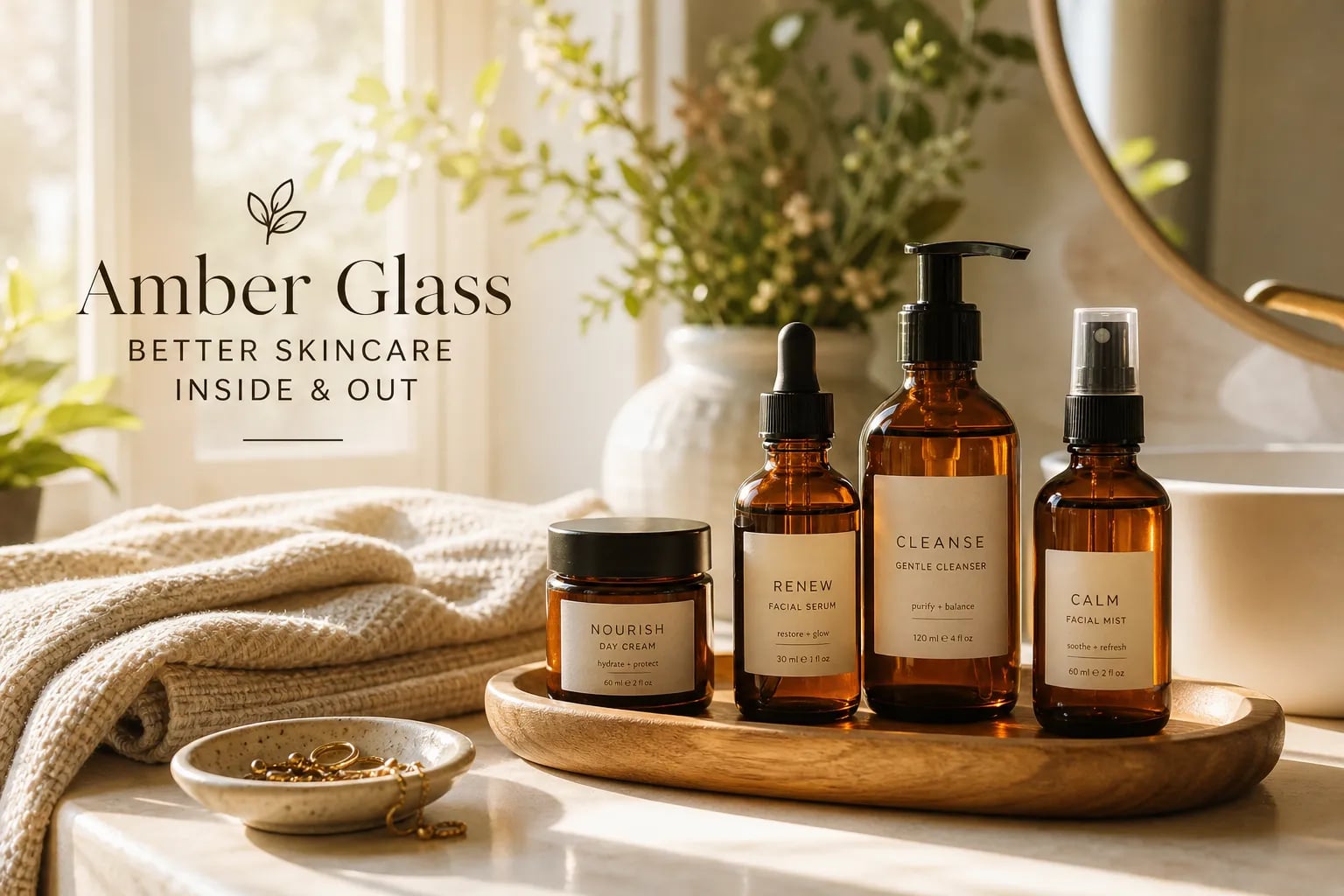
Amber glass carries decades of association with pharmaceutical quality and artisan production. Many indie and clean-beauty brands use it specifically to signal product seriousness, the warm brown tone reads as deliberate and minimal in a market where product integrity is a core brand promise. That visual language works without any explanation on the label, and many marketers in this space report that it helps communicate formulation care to first-time buyers.
How packaging material signals formula integrity
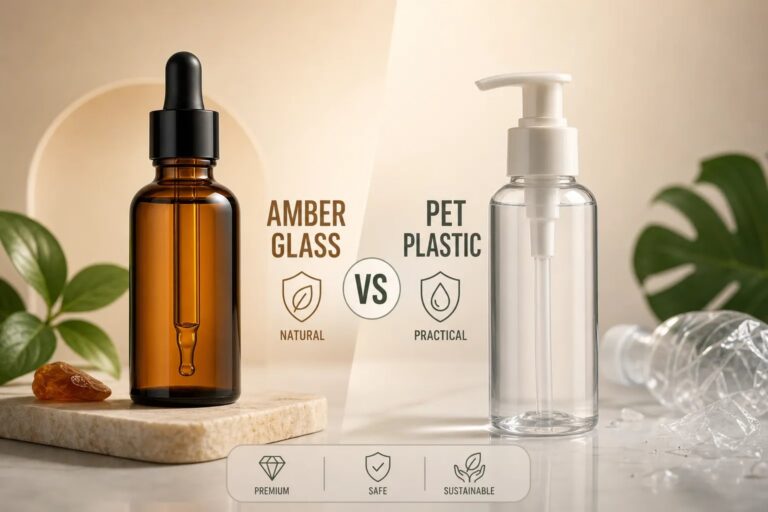
When a brand chooses amber glass over clear PET or brown glass skincare packaging alternatives like opaque plastic, it communicates that the formula inside is worth protecting. That story doesn’t need to be told explicitly; the packaging does it visually. Pairing a well-formulated, light-sensitive active with the right container gives the whole product a coherent narrative that experienced customers recognize immediately.
What to check before placing an amber glass order
Sourcing amber glass packaging involves more than finding a bottle you like the look of. Getting the compatibility details right before you commit to a full order saves real money and prevents delays at the worst possible time, like a launch week.
Neck finish and closure compatibility
The bottle’s neck finish determines whether the dropper, pump, or cap will seal properly. Nominal size descriptions are not enough; brands need the thread standard, finish drawing, and sealing surface dimensions confirmed before purchasing any closure separately. The safest approach is to buy and test the full assembled system, including the bottle, closure, pipette or dip tube, bulb, and inner liner, before committing to the full order quantity. Approving each component individually is not the same as approving the system.
Formula compatibility and system testing
Fill production-representative samples with the actual formula and test them over at least several weeks. Evaluate for leakage, evaporation, color change, pipette clouding, and dispensing consistency. For oils, alcohols, and low-pH actives, test the closure elastomers and dip-tube material separately; the glass may be chemically compatible while the closure is not. This is especially relevant for vitamin C serums and botanical oil blends where ingredient chemistry can interact with rubber bulbs, plastic dip tubes, or liner adhesives.
MOQ structures, lead times, and total landed cost
Stock bottles typically carry lower MOQs than custom configurations. Decoration, special closures, and coatings each carry their own minimums. For indie brands placing their first amber glass order, a practical planning range is 500–1,000 units for stock bottles with a 2–6 week lead time from a wholesale supplier. Total landed cost should include not just the bottle price but also components, freight, duties, and a breakage allowance, since glass loss in transit is a real variable in any cost model.
Where do indie brands source amber glass without factory minimums?
Access to quality amber glass skincare packaging has historically been gated by high factory minimums. Most direct factory sourcing requires 10,000–30,000 units per SKU to unlock bulk pricing, which is the right model for established brands with predictable sell-through. For a brand launching a 300-unit serum run, that quantity is a cash-flow risk, not an opportunity.
Why MOQ is the real obstacle for small brands
The minimum order quantity problem isn’t just about cost per unit; it’s about risk. Ordering 20,000 amber dropper bottles before a formula is market-tested means a large portion of that investment is locked in packaging before you know whether the product will sell. Small brands need access to professional-grade containers in manageable quantities so they can validate the market, refine the formula, and scale with confidence rather than over-committing upfront.
What BOBOPKG offers for amber glass skincare
We stock amber glass bottles and jars across the most common formats and sizes, from 5 ml dropper bottles through to larger 100 ml pump and spray configurations. Our low MOQ options are designed specifically for indie brands ordering in the 50–500 unit range, meaning a spa owner private-labeling a facial oil or an indie founder launching a vitamin C serum can access the same quality amber cosmetic containers that larger brands rely on, without a factory-scale commitment.
As brands grow and production volumes increase, we also offer bulk pricing, so the same supplier works across different stages of growth. Our catalog covers 3,000-plus SKUs, including amber dropper bottles, Boston rounds, wide-mouth cream jars, spray bottles, and roll-ons, so coordinating a full product line in matching amber glass is straightforward.
What to look for in a wholesale amber glass supplier
When evaluating any amber glass supplier, confirm that they can provide UV transmission data for the specific bottle model and amber color in their stock, not just a general claim about UV protection. Neck finish specifications should be documented with thread standards and dimensions, not just described by name. Verify that compatible closures are stocked alongside the bottles, since sourcing the bottle and dropper from two separate suppliers adds coordination risk. Finally, ask how lead times hold across repeat orders, not just the first purchase, consistency matters as much as the initial stock availability.
Final thoughts on amber glass skincare packaging
Amber glass skincare packaging is a proven UV barrier, a meaningful shelf-life tool for light-sensitive formulas, and a visual asset for brands that want to communicate quality without saying a word. The investment makes clear sense for any formula containing retinol, vitamin C, essential oils, or plant-based actives that degrade under UV exposure.
Amber glass doesn’t replace good formulation practices, airtight closures, or proper storage guidance, but as a first line of passive photoprotection, it performs better than clear glass by a margin that matters. For highly unstable actives, it works best as part of a system that includes oxygen-limiting dispensers and minimal headspace. For most indie beauty brands working with serums, facial oils, and botanical extracts, it’s the single packaging decision that delivers the most formula-protection value for the investment.
If you’re ready to source amber glass skincare bottles and need a supplier that works with indie-sized orders, reach out to our team at BOBOPKG. We carry the range, the specs, and the flexibility that small brands actually need. We’re here to help you find the right container format, closure, and size before you commit to a full order.
Frequently Asked Questions
Will amber glass remove the need for an outer carton or opaque wrap for light-sensitive products?
Sometimes, amber glass often reduces the need for an outer carton for moderately light-sensitive products, but it does not always eliminate it. For highly unstable actives or when visible light above 450 nm is a concern, brands pair amber glass with an outer carton or opaque label wrap to block remaining light exposure.
Does amber glass prevent oxidation or heat-related degradation of my formula?
No, amber glass reduces photodegradation but does not stop oxidation or heat damage. For best shelf life, combine amber glass with tight closures, minimal headspace, and proper storage guidance because oxygen, heat, and pH-driven breakdown continue regardless of bottle color.
How can we be sure a specific amber bottle SKU delivers the UV protection we need?
Request UV transmission specs for the exact bottle model and wall thickness rather than judging protection by color alone. Measured spectral data vary with amber depth and thickness, so verify supplier-provided transmission figures for the SKU you plan to buy and test the full assembled system with your formula.
What order sizes and lead times should we plan for when sourcing stock amber glass containers?
For stock bottles, plan a practical range of 500–1,000 units with a typical lead time of 2–6 weeks from a wholesale supplier. Smaller indie-focused options also exist, some suppliers offer low MOQ choices in the 50–500 unit range to accommodate small-batch launches.