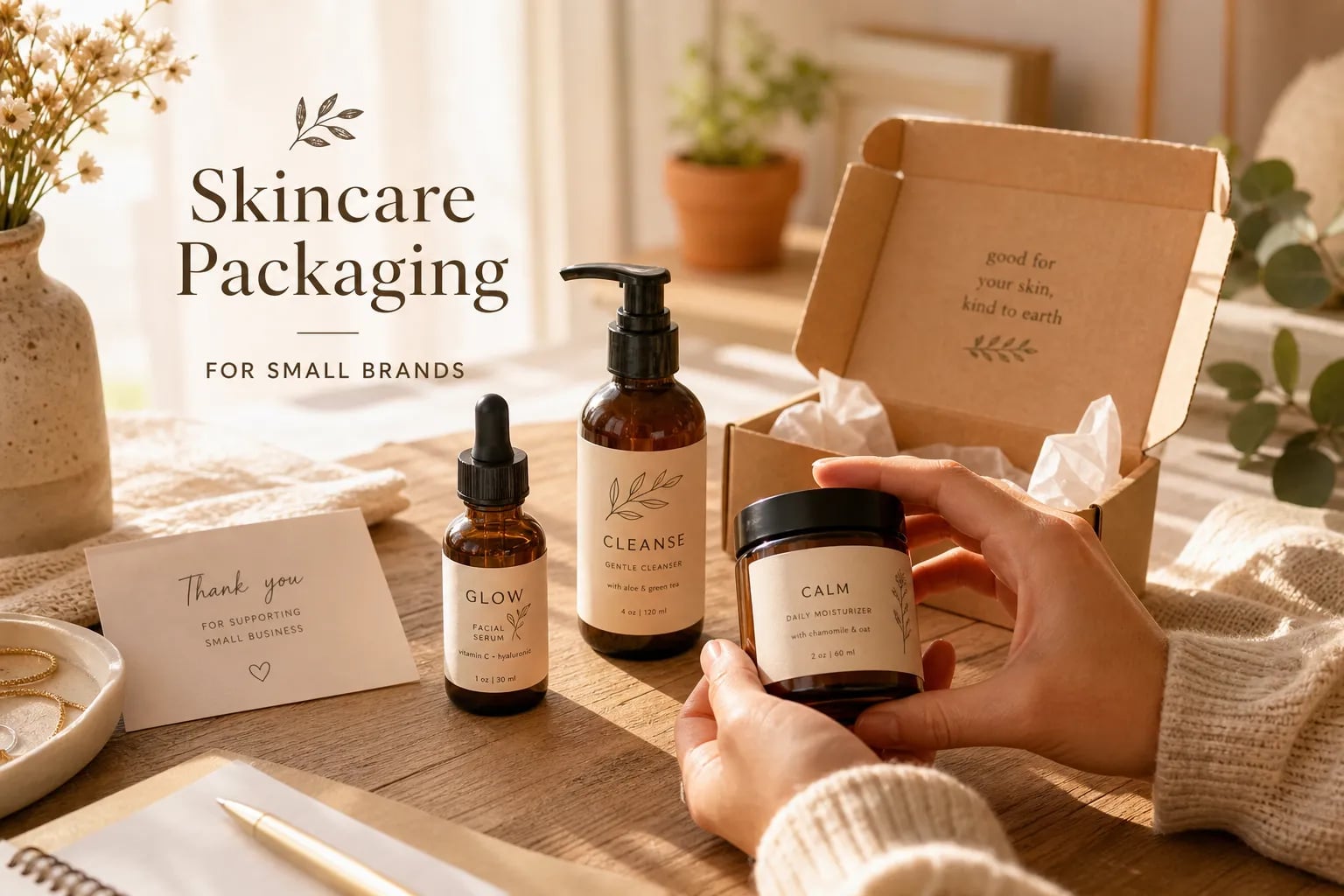
You’ve spent months perfecting your formula. You know the actives, the viscosity, the scent profile. Then you open a supplier catalog with hundreds of container options and the whole project stalls. Skincare packaging for small brands is one of the first operational hurdles founders hit during product development, and it’s genuinely difficult, not because the information is hidden, but because nobody hands you a decision framework when you’re starting out.
The stakes are real. Put the wrong formula into the wrong material, and you accelerate degradation before the product reaches a single customer. Order a gorgeous container without confirming the MOQ, and you’re sitting on 1,000 units of something your brand has already outgrown. Poor packaging also signals a poor product, even when the formula inside is excellent.
This guide walks you through four decisions that matter most: material, closure type, fill volume, and MOQ. Get these right in order, and the rest of the sourcing process becomes manageable. Working with the right wholesale supplier, especially one built for brands ordering in the 50-to-500 unit range, makes the whole process far less daunting than it looks from the outside.
1. Why packaging does more than hold your product
The container is your formula’s first line of defense. Packaging isn’t an afterthought or a branding exercise bolted onto the end of product development. It’s a functional component of the product itself, and it deserves the same deliberate attention you gave your ingredient list.
How the container protects what’s inside
Every formula has enemies: UV light, oxygen, and microbial contamination. UV exposure breaks down retinoids, vitamin C, and most botanical actives within days if the container offers no light protection. Oxygen contact causes oils to oxidize and emulsions to go rancid faster than any preservative system can compensate for. The material and closure you choose are formula decisions first, visual decisions second.
What a customer sees before they feel anything
Before anyone opens your product, they judge it. For indie brands selling online, in boutiques, or at markets, the container is often the first physical touchpoint a customer has with your brand. Professional-grade packaging signals quality and communicates that the person behind the label takes their craft seriously. A dropper bottle with a clean matte label reads very differently than the same formula in a repurposed grocery store jar, even when the product inside is identical.
The financial risk of ordering the wrong thing
A packaging mistake at small quantities is expensive in ways that go beyond the cost of the containers themselves. You lose the inventory, the fill time, and often the launch window too. If the container turns out to be incompatible with your formula, or the label doesn’t fit, or the closure fails after a few uses, you’re looking at a full reorder and potentially a reformulation review. Doing the research upfront is the cheapest thing you can do.
2. Skincare packaging for small brands: four decisions to nail
Packaging sourcing tends to go sideways when founders make decisions out of sequence. You can’t choose a closure before you know the material. You can’t estimate your MOQ commitment before you know your fill volume. Here’s the decision order that keeps the whole process coherent.
Material: what the container is made of
Material is the foundational choice because it determines formula compatibility, preservation performance, cost per unit, and shipping weight. Every downstream decision, including your closure options and label surface, flows from this one.
Closure: how the product is dispensed
The closure shapes the entire use experience. A dropper delivers precision dosing for a serum; a foam pump transforms a liquid cleanser into foam; an airless pump protects an oxidation-prone formula every time it’s used. Different formulas need different dispensing mechanisms, and getting this wrong frustrates the end customer even when the formula itself is excellent.
Fill volume: how much goes in each unit
Fill volume is the bridge between your batch size and the number of retail units you actually produce. It also determines how the filled container looks on a shelf and whether the lid seals correctly. Getting this number confirmed before you order containers saves you from a very common and avoidable mismatch.
MOQ: how many units you’re committing to
MOQ is the minimum order quantity a supplier requires per SKU. For small brands, this single number can derail an entire sourcing plan. Many new founders are surprised to discover that factory-direct minimums are often set at 1,000 to 5,000 units, far beyond what makes sense for a small-batch launch.
3. Glass vs. plastic: what your formula actually needs
The glass vs. plastic question comes up in almost every early packaging conversation, and the honest answer is that it depends on your formula. Both materials have genuine advantages, and choosing correctly starts with knowing what each one actually does for the product inside.
When glass is the better choice
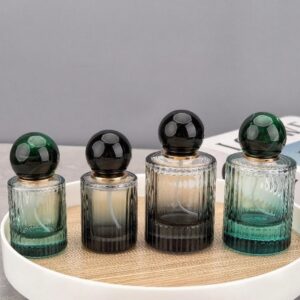
Glass is chemically inert, meaning it won’t react with or leach into your formula. That matters especially for high-actives serums, facial oils, essential oil blends, and any product where preservative chemistry is complex or minimal. Glass also has excellent barrier properties and pairs naturally with dropper and pump closures. The practical tradeoffs are weight, which increases shipping costs, and breakage risk during transit, which requires thoughtful secondary packaging.
Where PET and HDPE plastic earn their place
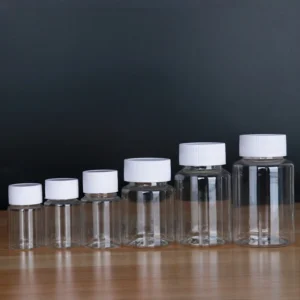
Food-grade PET and HDPE plastic are compatible with most water-based formulas, including toners, body washes, and lightweight lotions. They’re significantly lighter than glass, which reduces shipping costs at scale, and they cost considerably less per unit, often 30 to 50 percent less than glass equivalents. For brands building product lines where volume and price accessibility matter, plastic is the practical, professional choice.
Amber, violet, and cobalt glass explained
If you’re working with light-sensitive formulas, the type of glass matters as much as the material itself. Amber glass blocks most UV light and a significant share of visible blue and violet wavelengths, making it the standard recommendation for essential oils, retinoids, vitamin C, and botanical extracts. Amber glass delivers reliable, broad-spectrum protection at the lowest cost of the three options.
Cobalt blue glass protects better than clear glass, but it’s primarily an aesthetic choice, it doesn’t match amber’s UV-blocking range for the most photo-sensitive actives. Violet glass is the premium option: it blocks most visible light while allowing selective UV-A and infrared transmission, which some formulators choose for high-end or preservative-free products where both UV and visible light exposure are concerns. BOBOPKG carries amber and violet glass formats across multiple container sizes, so you can match protection level to formula sensitivity from a single catalog.
4. Closure types and why they matter as much as the bottle
A beautiful bottle with the wrong closure creates a frustrating customer experience, and frustrated customers don’t reorder. The closure controls how the formula comes out, how much comes out, and how well the container protects the product between uses.
Dropper bottles for serums and facial oils
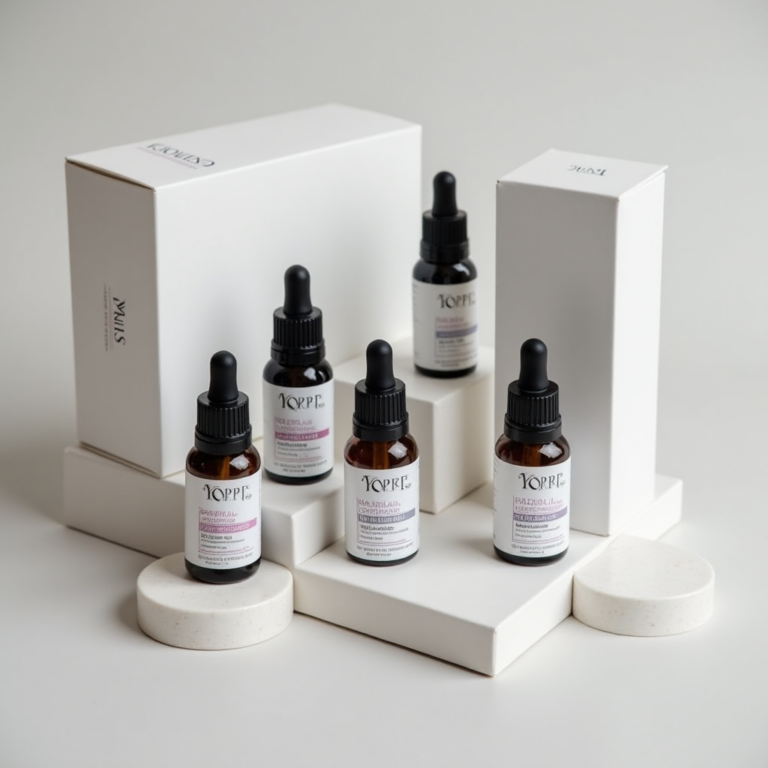
Droppers are the right choice for thin-to-medium viscosity formulas where precise dosing matters, including serums, facial oils, and tinctures. Glass pipette droppers pair naturally with amber or violet glass bottles, which is why this combination dominates high-actives skincare. One practical concern worth flagging: if the dropper tip contacts skin repeatedly during application, it creates a contamination pathway back into the bottle. That’s worth addressing in your product labeling and your preservation strategy.
Airless pump bottles for oxidation-sensitive formulas
Airless pumps use a vacuum-based dispensing mechanism where a rising piston delivers product without drawing outside air into the chamber. That means no oxidation between uses, exactly what you need for retinol creams, vitamin C serums, and peptide formulas that degrade on contact with air. Airless bottles typically run $1.45 to $4.00 per unit at 100-to-500-unit quantities, compared to $0.80 to $1.50 for standard pump bottles. That premium is worth it when formula stability depends on keeping oxygen out.
Spray and foam pumps for water-based products
Mist sprayers work well for micellar waters, facial mists, setting sprays, and toners, delivering an even distribution across a wide area with less product waste per application than pouring onto a cotton pad. Foam pumps require a specific low-viscosity formula ratio, typically a diluted cleanser with a surfactant concentration calibrated for foam generation. Not every cleanser formula will foam correctly in a foam pump, so test this pairing with your specific formula before committing to containers at volume.
Standard closures for creams, balms, and jars
Cream jars, balm containers, and solid products don’t need a dispensing mechanism. A well-fitting screw cap or disc cap is the right call, and over-engineering this with an airless system wastes budget without adding meaningful user benefit. For thick emulsions and balms, wide-mouth jars also make the fill process simpler during production, which matters when you’re filling by hand or with basic equipment.
5. Fill volume, headspace, and the math most brands miss
Most new founders order containers based on the labeled size and assume the formula fills neatly to the top. It doesn’t work that way. Fill volume and headspace are distinct from nominal capacity, and not understanding the difference leads to containers that look half-empty, lids that won’t seal, or formulas that expand and leak in transit.
How to calculate how many units you’ll get from a batch
Start with your batch size in milliliters and work backward from your target fill volume. A 1,000 mL batch going into 30 mL dropper bottles doesn’t give you a clean 33 units. A standard 30 mL dropper bottle has a brimful capacity closer to 33 to 36 mL, and the actual usable fill is typically 27 to 30 mL once the dropper insert occupies internal space and headspace is accounted for. Confirm usable fill volume with your supplier before placing an order, then divide your batch size by that number to get your actual unit yield.
Why headspace matters for stability and aesthetics
Headspace is intentional, not a sign that a container is underfilled. That empty volume between the product surface and the closure allows for thermal expansion during shipping and storage, ensures the lid seats properly, and prevents overflow during capping. For low-viscosity liquids like serums and toners, more headspace is typically needed to account for movement and filling tolerance. Products with active preservative systems may also benefit from reduced headspace to limit air contact between uses.
Matching container size to your formula viscosity
Thick creams and balms don’t flow through narrow-neck bottles without specialized filling equipment. Thin serums dispensed through a wide-mouth jar without a dropper or pump are hard to control at the point of use and can feel messy or imprecise. Before finalizing any container, confirm that your formula can be physically filled through the opening you’ve chosen and that the closure controls the pour rate in a way that makes sense for how the customer uses the product.
6. MOQ explained: what low-minimum sourcing actually means for small brands
For small-batch founders, MOQ is the number that determines whether a particular supplier is actually accessible to you, not just impressive in catalog size.
What MOQ means and why factories set it high
MOQ, or minimum order quantity, is the fewest units a supplier will produce or sell per SKU per order. Factories set high minimums because each production run has fixed setup costs: tooling, color matching, equipment changeovers, and quality control processes that don’t scale down efficiently. For brands sourcing directly from overseas manufacturers, MOQs of 1,000 to 5,000 units per SKU are common. That’s a real barrier for a small-batch brand that needs 200 units of a serum bottle to validate a new product before committing to a full production run.
Stock packaging vs. custom packaging minimums
Stock packaging refers to standard container shapes already in production, available off the shelf with no custom molding required. These carry the lowest MOQs, sometimes as few as 50 to 100 units, because no new tooling is needed. Custom packaging, whether that means proprietary mold shapes, embossed logos, or specialty decoration, requires tooling investment and significantly higher minimums, often 1,000 units or more, plus a tooling fee that can run several hundred to several thousand dollars before a single unit is produced. For most small brands, stock packaging paired with custom labels and thoughtful label printing for skincare is the right starting point, and the most budget-conscious path to a professional finished product.
Why a broad catalog at low MOQ changes the game
This is where working with a wholesale supplier like BOBOPKG makes a measurable difference. BOBOPKG stocks more than 3,000 ready-to-ship containers spanning dropper bottles, airless pumps, amber and violet glass, cream jars, PET bottles, spray bottles, and specialty formats, all with low MOQs built for brands in the 50-to-500 unit range. Instead of committing to 2,000 units of a container you’ve never tested, you can order 100 units, fill them, label them, get them into customers’ hands, and make an informed decision before scaling up. As your brand grows, bulk pricing and custom quote options are available through BOBOPKG so your supplier relationship scales right along with your volume.
7. U.S. labeling rules every small brand must know before printing
Choosing a container before you’ve mapped out your label layout is a sequencing mistake that catches a surprising number of small brands off guard. Federal labeling requirements under the FDA and the Fair Packaging and Labeling Act (FPLA) dictate what information must appear on your label and exactly where. Knowing these rules before you finalize your container saves you from ordering packaging that physically can’t accommodate a compliant label.
What the FDA requires on every skincare label
Every cosmetic sold in the U.S. must include five core label elements:
- A product identity statement (what the product is, such as “face serum” or “moisturizer”)
- The net quantity of contents expressed in weight or volume
- A full ingredient declaration in descending order of predominance using INCI names
- The name and place of business of the manufacturer, packer, or distributor, including address
- Any applicable warnings or directions for safe use
All required information must appear in English. The FDA does not require premarket approval for most cosmetics, but these labeling elements are non-negotiable before you sell a single unit.
Principal display panel vs. information panel
Your label has two functional zones. The principal display panel (PDP) is the front-facing surface a consumer sees at retail, and it carries the product identity statement and the net quantity of contents. The information panel, typically the back or side of the container, carries the ingredient list, business address, and any required warnings. Understanding this division before you design anything means you allocate label real estate correctly from the start and avoid cramming required elements into the wrong location at the last minute.
How container size and shape affect label compliance
Small containers create real compliance pressure. A 15 mL roller bottle still needs all five required label elements, and they all still need to be legible. Before you order containers, mock up a physical label at the actual dimensions of your container and confirm that every required element fits clearly. This is especially important for travel-size or sample-size formats where limited label surface area and small font sizes can quickly become a compliance issue. Working with a label printing specialist who has experience in label printing for skincare products can help you avoid common layout mistakes before you go to press.
8. A note on sustainable skincare packaging
Sustainability is increasingly part of the sourcing conversation for small brands, and the options have expanded meaningfully. Recycled PET (rPET) offers the lightweight, cost-efficient profile of standard PET plastic with a lower carbon footprint. Refillable formats, where the outer container is retained and only the inner component is replaced, can reduce total packaging waste for high-repeat-purchase products like moisturizers and cleansers. Glass, while heavier in transit, is infinitely recyclable and resonates strongly with ingredient-conscious consumers. The right sustainable skincare packaging choice depends on your formula, your price point, and how your customer base weighs environmental considerations. When in doubt, start with a material that performs well for your formula first, then layer in sustainability credentials where they don’t compromise protection or usability.
9. How to vet suppliers and place your first packaging order
Sourcing packaging for a small brand is a process, not a single purchase. The brands that launch with packaging they’re proud of are almost always the ones that sampled first, briefed clearly, and chose a supplier whose catalog matched their actual scale.
Always sample before you buy in volume
Request samples of any container you’re seriously considering before committing to a bulk order. Sampling lets you verify closure function, check material feel and weight, confirm fill volume against your batch size, and test whether your formula viscosity flows correctly through the opening and closure. Run a sample label on the physical container too, to confirm that label dimensions work and that the cap seats cleanly after repeated opening and closing. The cost of samples is almost always less than the cost of a wrong bulk order.
Build a packaging brief before you contact any supplier
A packaging brief is a short document that gives a supplier everything they need to quote accurately and respond quickly. It should cover your product type and formula viscosity, your target fill volume, preferred material and closure type, the quantity you need for this order, and any label or decoration requirements. Suppliers respond to dozens of inquiries every day. A complete brief gets you a faster, more accurate quote and signals that you’re a serious buyer worth prioritizing.
Finding a supplier that fits your scale
For U.S. small-batch brands, BOBOPKG is a practical first stop. The catalog covers dropper bottles, airless pump bottles, amber and violet glass, PET containers, cream jars, spray bottles, and candle tins, all at low MOQs designed for founders who need professional-grade options without factory-scale commitments. Global delivery and multi-currency pricing mean international brands can source from the same catalog as easily as U.S.-based buyers. When your brand is ready to scale, bulk pricing and custom quote options are available directly through BOBOPKG so you don’t need to rebuild your supplier relationships at higher volume. Reach out to the BOBOPKG team to request samples or get a custom quote for your next product launch.
Your next step starts with four decisions
Packaging your skincare brand comes down to four decisions made in the right order: material, closure, fill volume, and MOQ. When you make them sequentially and understand how each one connects to the next, the process becomes far less overwhelming. You stop shopping by aesthetic and start sourcing by formula compatibility, fill accuracy, and practical scale.
The lowest-risk path forward is to order samples first. Pick two or three containers that match your formula’s material and viscosity requirements, fill them, label them physically, and run real-use testing before you commit to volume. The time that process takes is nothing compared to the cost of relaunching with different packaging six months after your initial order.
Order samples to validate your skincare packaging for small brands before you commit to volume, then browse the full BOBOPKG catalog or get in touch with the BOBOPKG team directly. With low MOQs across thousands of SKUs and bulk pricing for brands that are scaling, the catalog is built for exactly the stage you’re in right now.
 English
 Français
 Deutsch
 Español