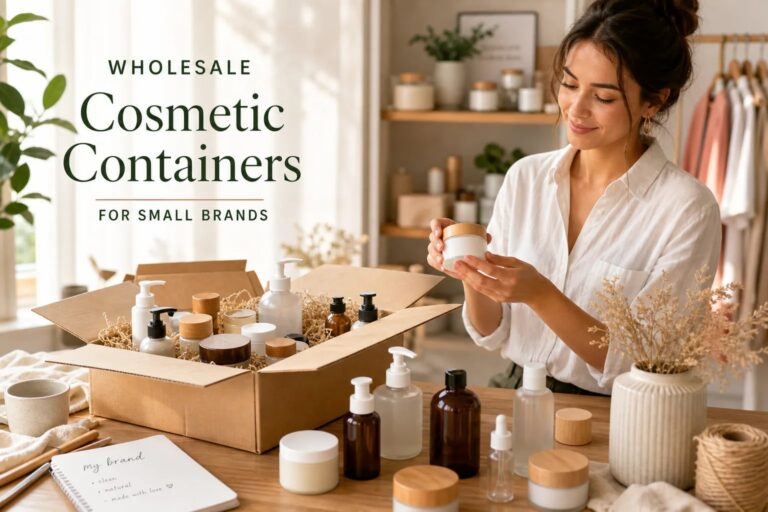
If you’re searching for a minimum order packaging supplier for your indie beauty brand, this guide breaks down how to compare options and avoid overspending. Most wholesale beauty container suppliers work with MOQs in the 100–1,000 unit range for stock packaging, while custom printed boxes from low-MOQ vendors typically start around 25–100 units. That means as a small brand, you don’t need to place a factory-scale order to get professional packaging. You just need to know which suppliers actually serve your size. Here we break down how minimum order quantities work in the packaging world, how to compare your options, and what questions to ask before you commit a single dollar. Suppliers like us at BOBOPKG have built our entire catalog around brands at this stage, so the options are more accessible than most indie founders realize.
The confusion usually comes from mixing up two very different categories: the actual container (your bottle, jar, or pump) and the branded outer packaging (your mailer box or folding carton). These two packaging types come from different supplier categories, follow different MOQ logic, and have very different cost structures at small quantities. Getting clear on that distinction first makes every other sourcing decision easier.
Key takeaways
- Stock containers start lower: Wholesale beauty containers like dropper bottles and cream jars are commonly available starting at 100–500 units for glass and 100–1,000 units for plastic from US-accessible stock suppliers, making them the most accessible primary packaging for small brands. Some wholesalers offer smaller case-quantity listings, but confirm MOQs for your specific container type.
- Custom boxes need digital printing: For branded outer packaging at 25–100 units, digital printing is the right model, it eliminates plate and setup fees that offset printing adds to small runs.
- Hidden fees change everything: Per-unit price alone is a misleading comparison. Setup charges, freight, sampling, and tooling can add 20–50% above the initial quote.
- Lead times vary by supplier type: Domestic stock packaging ships in 1–2 weeks; custom-printed boxes typically need 2–4 weeks door to door; imported stock can take 4–8 weeks.
- Print-on-demand fills a gap: POD is a viable no-minimum option for outer packaging and inserts, but it cannot replace a primary container supplier.
- Start with samples: Before committing to 200+ units of anything, validate fill compatibility, closure fit, and label adhesion with a small sample run.
What “minimum order quantity” actually means in packaging
A minimum order quantity is the smallest number of units a supplier will produce or sell in a single transaction. It is not arbitrary. Suppliers set MOQs because every production run carries fixed costs, setup time, material waste during calibration, labor for changeovers, and quality inspection overhead, that only make economic sense once spread across enough units. When a supplier produces fewer units, those fixed costs land on a smaller denominator, which either raises the per-unit price significantly or makes the order unprofitable entirely.
The practical implication for small brands is that MOQ reflects where a supplier’s business model starts. A factory set up to run 10,000 units at a time simply cannot serve a 50-unit order profitably without charging a premium that makes the order irrational for the buyer. That is not a negotiating failure, it is structural incompatibility. The goal is to find suppliers whose infrastructure and pricing are designed for the volume you are actually ordering.
How MOQ differs between stock and custom packaging
Stock packaging and custom packaging follow completely different MOQ logic, and confusing the two is one of the most common mistakes small brands make. Stock packaging refers to pre-manufactured containers already produced in standard shapes, sizes, and finishes. You are buying from existing inventory. Because there is no production setup required for your specific order, MOQs for stock containers can start lower than custom options, though typical ranges still vary by material (see the section below).
Custom packaging means printed or branded items produced specifically to your specifications: your logo on a mailer box, your brand colors on a folding carton, your artwork on a printed label. That requires setup work, artwork prep, dielines, digital proofing, even if no physical plates are involved. For custom printed outer packaging, minimums from low-MOQ digital-print vendors typically start around 25–100 units. Neither category requires a factory-scale commitment when you source from a minimum order packaging supplier built for smaller brands.
How to Choose a Minimum Order Packaging Supplier: MOQ Ranges to Expect
Container packaging: bottles, jars, pumps, and droppers
For core beauty containers, realistic MOQ ranges depend on the container type and whether you are buying from a domestic stock supplier or importing directly. Glass dropper bottles and glass cream jars from US-accessible stock suppliers typically start around 100–500 units. Plastic jars and bottles generally run 100–1,000 units. Airless pump bottles tend to carry higher minimums, commonly in the 500–2,500 unit range because of the mechanical complexity of the dispenser component.
At BOBOPKG, we have designed our wholesale catalog specifically around brands that need smaller quantities. With 3,000+ SKUs across glass and plastic containers, including amber glass, violet glass, dropper bottles, airless pumps, roll-ons, and spray bottles, we serve indie brands that need professional-grade primary packaging without committing to thousands of units. If you are building a small-batch serum line or launching a new spa treatment oil, you can start at quantities that match your actual production run, not a factory’s production schedule.
Custom boxes, mailers, and outer packaging
For branded outer packaging, the low-MOQ landscape has expanded meaningfully. Digital-print vendors like Packlane, Fantastapack, Packola, and Teal Packaging now serve small brands with minimums that make branded unboxing experiences financially accessible. Fantastapack accepts runs as low as 30 units for certain custom box formats. Packlane starts around 50 units for custom mailers and 60 units for some custom box styles. Teal Packaging generally starts at 50 units, though rigid box formats may require 100 units depending on specifications. As of our last check, Ucanpack starts custom mailer runs at 25 units, though you should confirm current minimums directly with the vendor.
How print-on-demand packaging fits in
Print-on-demand is a genuinely no-minimum option for outer packaging, branded mailers, and inserts. Suppliers like Printful and Printify let you produce one unit at a time with no upfront inventory commitment. The trade-off is a higher per-unit cost and a more limited selection of structural formats. POD is well suited to testing a new product concept or fulfilling very low-volume launches before you have a confirmed SKU with consistent sell-through.
The important limitation: print-on-demand cannot help you with your primary container. No POD platform will produce a glass dropper bottle or an airless pump serum dispenser for a single-unit order, that gap is exactly where wholesale stock suppliers come in.
What types of packaging suppliers actually serve small brands?
Wholesale stock suppliers with flexible MOQs
Wholesale stock suppliers are the most practical starting point for beauty brands sourcing primary packaging. These suppliers hold inventory of pre-manufactured containers and sell them in smaller lots, without requiring custom molds, long production runs, or factory-scale commitments. The right wholesale supplier in this category gives you access to dozens of container formats at quantities that fit a real small-batch launch.
This is the category BOBOPKG is built for. Our catalog covers 3,000+ SKUs including glass and plastic bottles, cream jars, dropper bottles, foam pumps, roll-ons, candle tins, and UV-protective amber, cobalt, and violet glass containers. We serve 1,000+ brands worldwide with global delivery and multi-currency pricing across USD, EUR, GBP, CAD, MXN, JPY, and BRL. For indie beauty brands, spas, and wellness sellers who need professional packaging without a factory minimum, this is the most direct path to containers that protect your formulas and present well on a shelf.
Custom packaging vendors for branded outer boxes
Once you have your primary container sorted, branded outer packaging is the next layer. Custom-print vendors specialize in folding cartons, corrugated mailers, rigid gift boxes, and shipping boxes with your artwork applied via digital printing. The key advantage of digital printing at small quantities is the elimination of plate and setup fees. Offset printing adds plate charges per run that make a 50-unit order economically irrational. Digital-print vendors commonly avoid those plate fees for short runs, though other charges, artwork processing or die fees for specialty structures, may still apply.
Turnaround times for custom-printed boxes from digital vendors typically run 10–20 production days after proof approval, with transit adding another 1–7 days depending on destination. Some digital specialists complete production in 6–10 business days total with standard ground shipping. Plan for 2–4 weeks door to door as a realistic working timeline for a first order, and add buffer time for artwork revisions and proof approval on the initial run.
Print-on-demand: when it makes sense (and when it doesn’t)
POD platforms work well for a specific scenario: you need branded outer packaging or inserts for a very small or uncertain launch, and you want zero inventory risk. Printful publishes sample discounts for eligible accounts and typically dispatches samples within a few business days before shipping, check Printful’s current sample and shipping policy page for rates and eligibility. The per-unit cost is higher than a small-run digital print order, but there is no minimum and no leftover inventory if the product doesn’t sell.
Where POD breaks down is structural variety and primary packaging. You cannot source a serum bottle, a cream jar, or an airless pump through a POD platform. For those, you need a wholesale stock supplier. POD is a complement to your packaging strategy, not a complete solution.
How to compare minimum order packaging suppliers before choosing one
The most common mistake in supplier evaluation is treating the per-unit price as the primary comparison metric. Hidden fees can add 20–50% above the initial factory quotation for a small run. The only meaningful comparison is an itemized, all-in cost per usable unit.
Use this framework when evaluating any minimum order packaging supplier for a small-batch order:
| Criterion | Wholesale stock supplier | Custom-print box vendor | Print-on-demand |
|---|---|---|---|
| MOQ | 100–500 units (glass); 100–1,000 units (plastic) for stock | 25–100 units (digital print) | 1 unit (no minimum) |
| Lead time | 1–2 weeks domestic stock; 4–8 weeks imported | 2–4 weeks door to door | 2–7 business days production; transit on top |
| Setup fees | None for stock containers | None for digital printing; plate fees apply for offset | None |
| Stock reliability | High for in-stock items; reorder consistency is a key differentiator | Printed to order; no stock dependency | Printed to order; no stock dependency |
Lead time reliability deserves more weight than most brands give it. A supplier that takes 6+ weeks to fulfill a reorder creates a real operational risk when you sell through faster than expected. For stock containers especially, knowing a supplier holds consistent inventory and ships quickly is worth paying a modest premium per unit to avoid stockouts that shut down your production schedule.
Questions to ask a supplier before placing your first order
Questions about MOQ flexibility and scaling
Not all low-MOQ suppliers are set up to grow with you. Before you commit to a first order, ask whether the MOQ changes if you order multiple SKUs in the same transaction, whether bulk pricing kicks in at a specific volume threshold, and whether you can mix sizes or colors within a single minimum order. These questions reveal whether the supplier’s model is designed for brands at your stage or whether the low MOQ is a marketing claim that only applies to a narrow set of products.
Also ask directly whether MOQ requirements change for reorders versus first orders. Some suppliers offer lower minimums on the initial purchase to win new customers, then impose higher minimums on subsequent runs. Knowing this upfront lets you plan inventory and cash flow realistically rather than discovering the gap mid-reorder cycle.
Questions about fees, lead times, and what’s actually included
Get the full cost picture before you approve anything. The core questions: Are sample costs credited toward the first full order? Are there setup, plate, or die fees for custom printing, and do they recur on reorders? What is the production turnaround separately from transit time? How is shipping calculated, by weight, by dimensional weight, or by a flat rate? Each of these variables can shift your all-in cost per unit by a meaningful amount on a small run.
Freight is especially worth scrutinizing. Depending on origin, volume, and destination, freight costs can add meaningfully to your landed cost, request destination-specific freight quotes from any supplier you’re seriously evaluating rather than relying on estimates. For domestic stock suppliers, shipping is usually faster and more predictable than for imported goods, which is another reason to prioritize domestic-stock options when speed and cost certainty matter.
Red flags to watch for with low-MOQ vendors
Minimum orders that change at checkout
One of the most common frustrations in small-batch packaging sourcing is a supplier that advertises a low MOQ on the product listing page but applies a different, higher minimum when you specify a custom size, a particular finish, or a printed version of the same container. Rigid boxes are especially prone to this: some suppliers list 50 units on a category page but require 100 units on the product spec sheet for specialty rigid formats. Always confirm the MOQ in writing for the exact product, the exact size, the exact finish, and the exact quantity you plan to order.
This is not necessarily bad faith, it reflects the genuine complexity of packaging production, where different formats, coatings, and structures have different setup cost profiles. But it does mean that a headline MOQ number is not a reliable comparison point until you have confirmed it against your specific order requirements.
Low unit prices that hide expensive setup fees
The offset printing trap catches many small brands: a per-unit price looks very attractive, but the quote excludes plate fees that make the total order cost irrational at 50–100 units. For any small run, digital printing with no setup fees is almost always the right model. The per-unit price may be slightly higher than offset, but the absence of fixed plate costs keeps the total order cost reasonable at the quantities small brands actually order.
Also watch for suppliers who charge for samples without crediting the amount toward the first production order. A well-structured sample program should work in your favor: you pay a modest amount to validate the product, and that amount applies to your first real order. Suppliers who charge for samples with no credit are charging you twice for the same product decision.
How to place your first small-batch order without overcommitting
Start with samples to validate before you scale
The single most important step before placing a production order is validating your packaging with samples. For stock beauty containers, most wholesale suppliers, including us at BOBOPKG, allow sample ordering so you can check the packaging thoroughly before committing to a larger run. For custom-printed outer packaging, most digital-print vendors can produce a proof or small prototype run before you approve production.
At the sample stage, check these four things:
- Does the container’s fill line match your formula’s volume?
- Does the closure seal properly without leaking or dripping?
- Does your label material adhere cleanly to the surface finish?
- Does the printed artwork match your digital file accurately?
Catching a mismatch at the sample stage on a 3-unit test costs a fraction of discovering it after a 300-unit production run.
Build a sourcing plan that grows with your brand
Think of packaging sourcing in phases rather than as a single decision. In the launch phase, start with stock containers at a quantity that fits your production run to test sell-through and validate your formula. Add branded outer packaging once you have a confirmed SKU that is selling consistently. As your volume grows and your per-SKU quantities increase, you can shift from small digital-print runs to larger print quantities with better per-unit economics. The packaging infrastructure scales with the brand rather than front-loading a capital commitment the brand hasn’t earned yet.
This phased approach also lets you change packaging decisions without writing off large inventory investments. If you launch with stock amber glass dropper bottles and decide three months in that you want a custom bottle shape, you haven’t committed significant capital to a custom mold before proving demand. Stock containers with branded labels are a fully professional presentation that doesn’t require a custom mold to look like a real brand on a shelf.
FAQ: Minimum Order Packaging Supplier Questions
What is a realistic MOQ for a small beauty brand just starting out?
For stock containers, most US-accessible wholesale suppliers start at 100–500 units for glass and 100–1,000 for plastic. For custom-printed outer boxes, digital-print vendors typically start at 25–100 units. If you need true no-minimum options, print-on-demand platforms cover outer packaging and inserts, but not primary containers.
Can I mix SKUs to meet a minimum order?
Some wholesale stock suppliers allow you to mix sizes or colors within a single order to reach a quantity threshold, but policies vary by supplier. Always ask before assuming, since some apply the MOQ per SKU rather than per order.
What’s the fastest way to get packaging for a first launch?
Domestic stock suppliers are typically the fastest option, with shipping in 1–2 weeks for in-stock containers. Custom-printed outer boxes from digital vendors add 2–4 weeks. If speed is the top priority, start with stock containers and plain or labeled packaging, then add branded boxes once your sell-through is confirmed.
Choosing the right packaging supplier starts with matching your size
The right minimum order packaging supplier is not necessarily the cheapest one per unit or the most recognizable name. It is the one whose business model is designed for the volume you are actually ordering right now. Small beauty brands have genuine, accessible options across wholesale stock containers, low-MOQ custom-print box vendors, and print-on-demand outer packaging. The key is knowing which type solves which part of your packaging problem.
For primary packaging, the actual container your formula goes into, a wholesale stock supplier with a wide format selection and flexible small-lot purchasing removes the biggest barrier to launching. At BOBOPKG, our catalog of 3,000+ SKUs covers the full range of glass and plastic containers indie brands need: UV-protective amber and violet glass, dropper bottles, airless pumps, cream jars, roll-ons, spray bottles, and more, all available to the 1,000+ brands we serve worldwide without factory-scale minimums.
Browse our catalog to find containers that match your formula type and brand aesthetic, or reach out to our team to request a quote for your specific SKU requirements. Getting the right packaging in the right quantity is entirely possible at the indie brand stage, you just need the right starting point.