


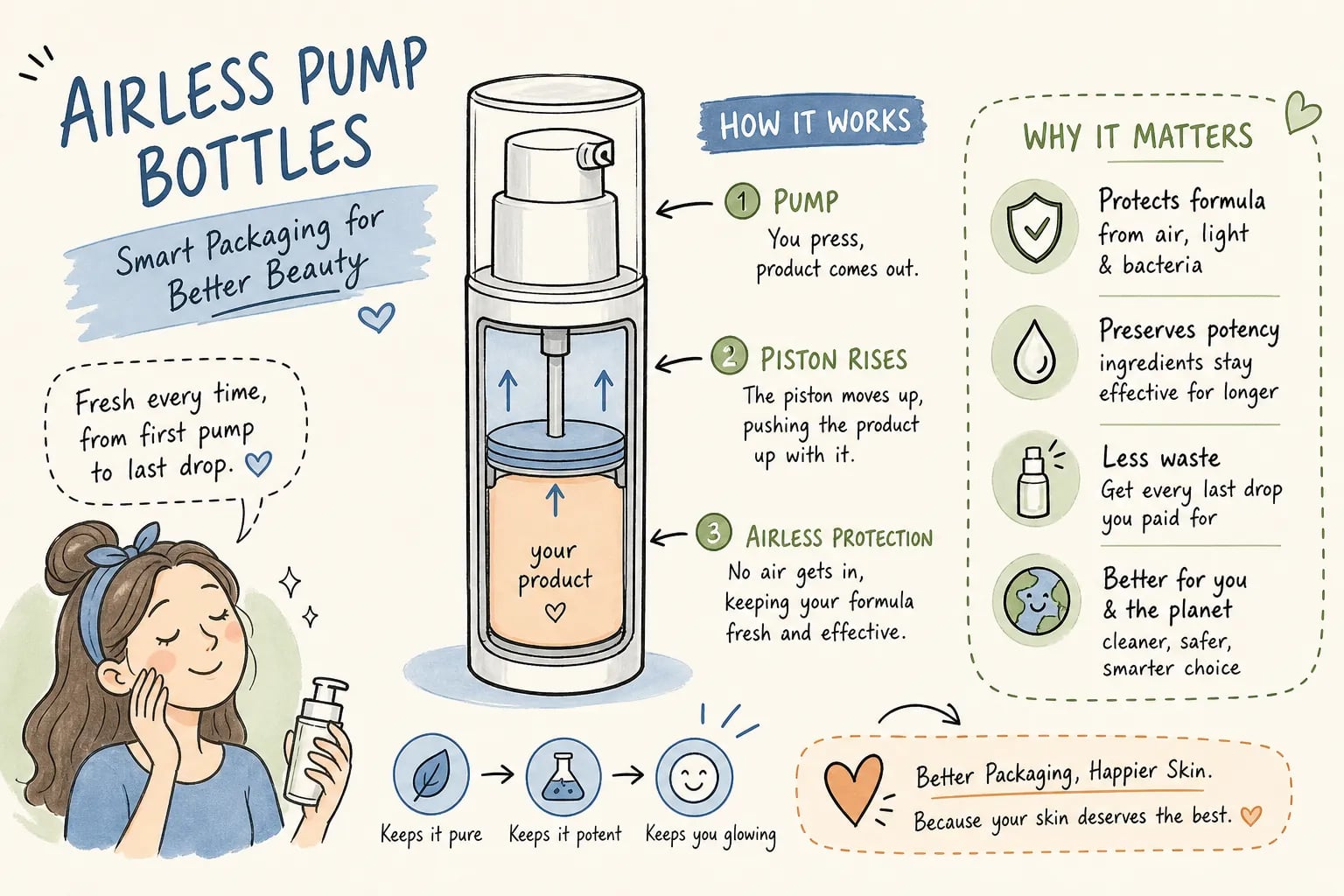
Airless pump bottles for cosmetics use a sealed piston or collapsible pouch to move product toward the nozzle without drawing air back into the container. That single mechanical difference is why they protect oxidation-sensitive formulas, deliver consistent doses, and evacuate a high percentage of the fill, none of which a standard dip-tube pump or open jar can reliably replicate. Whether airless pump packaging for cosmetics is right for your product depends on your formula’s viscosity, its ingredient sensitivity, and your production volume. This article gives you a direct framework to make that call: how the mechanism works, which formulas benefit most, how to write a supplier spec, what to test before a production run, and what questions to ask before your first order.
Key takeaways
- Air exposure is normally prevented: A rising piston or collapsing pouch replaces dispensed product volume, so oxygen and airborne contaminants are normally prevented or greatly reduced after each use, provided seals remain intact and undamaged.
- Best formula fit: Smooth, flowable creams, lotions, and gel serums in the 1,000–50,000 mPa·s viscosity range work best; balms, scrubs, and water-thin formulas typically do not.
- Material selection matters: Every formula-contacting component, bottle, piston, seal, valve, needs compatibility testing, not just the outer shell.
- Spec before you sample: Suppliers need your viscosity range, fill volume, dose target, and priming limit to recommend the right pump configuration.
- Testing is required: Airless packaging reduces air exposure but does not replace preservative efficacy testing or validated shelf-life studies.
- Low MOQ sourcing exists: You do not need factory-scale commitments to access professional-grade airless pump bottles for cosmetics; flexible wholesale options are available for small and growing brands.
How does an airless pump bottle actually work?
The basic piston mechanism
An airless bottle has no dip tube. Instead, a movable disc or piston sits at the base of the bottle and rises incrementally each time the actuator is pressed. Pressing the top creates a brief pressure drop that draws product upward through a one-way valve; then the piston advances slightly to close the gap. No outside air enters to replace what was dispensed.
Three main airless system types
The three main airless systems each suit different formula types. Piston designs are the most common airless dispenser bottle format and work best with medium- to high-viscosity creams, lotions, and gels, making them typically the first type a small brand will encounter. Bag-in-bottle pouch systems hold the formula inside a collapsible inner pouch that contracts as product is used, making them better suited to thin serums and fluid emulsions. Diaphragm designs occupy a specialty niche where precise dosing or unusual viscosity profiles require a different pressure architecture.
Why the piston design outperforms a dip tube
Because the piston pushes the formula toward the nozzle rather than relying on a straw and suction, airless pump bottles dispense reliably sideways or upside down. They also evacuate a higher percentage of the fill than a dip-tube pump, which leaves a layer of product unreachable at the base of the bottle. The table below compares the two mechanisms directly.
| Feature | Airless pump | Dip-tube pump |
|---|---|---|
| How product moves | Rising piston or collapsing pouch pushes product upward | Suction draws product up through a tube |
| Air in product chamber | Normally prevented during dispensing | Air enters to replace dispensed volume |
| Moving part inside bottle | Bottom piston/disc or flexible inner bag | No moving part in the bulk bottle |
| Residual product | Low: piston follows product toward the nozzle | Higher: product can remain on walls and at base |
| Angle performance | Dispenses sideways or inverted | Best performance upright only |
| Best formula fit | Viscous, air-sensitive, or high-value formulas | Simple lotions and liquids at standard viscosities |
| Cost | Higher: more complex components | Lower: fewer parts, widely available |
Why airless dispensers preserve cosmetic formulas better than standard pumps
Every time a standard dip-tube pump is actuated, it pulls air back into the bottle to equalize pressure. Over the product’s use cycle, that air introduces oxygen, humidity, and airborne contaminants directly into the formula. For ingredients like vitamin C, retinol, and botanical extracts, repeated oxygen exposure accelerates degradation and shortens effective shelf life well before the printed expiration date.
Airless packaging breaks that air-exchange cycle. The piston advances to compensate for dispensed volume, so the headspace above the product never refills with outside air, as long as the seals remain intact. This slows oxidative breakdown and supports longer formula stability. In some formulations it may allow a lighter preservative load, though it never eliminates the need for proper preservation and validated shelf-life testing.
Beyond oxidation, airless dispensers reduce the contamination routes that open jars and some pump bottles create. There are no fingers dipping into the formula, no exposed product surface collecting airborne particles, and no shared air between uses. Each actuation delivers a measurable, repeatable dose, which helps consumers apply consistently and reduces waste. When the piston reaches the top, the bottle is nearly empty rather than hiding a significant reservoir the pump can no longer reach.
Which formulas are the best fit for airless pump bottles for cosmetics?
Lotions and light-to-medium creams are among the strongest candidates. Their viscosity moves smoothly through the piston mechanism without clogging the valve or requiring excessive actuation force. Serums, particularly gel-based and treatment serums with oxidation-sensitive actives, also perform well when matched with the right pump engine for their viscosity. Standard piston-type airless systems are typically tested across a practical range of 1,000–50,000 mPa·s, with some conventional models performing best between 500 and 20,000 mPa·s.
Very thick balms, wax-heavy body butters, and grainy scrubs are generally poor fits: they either fail to prime or clog the valve and nozzle. Formulas at the other extreme, products close to water-thin, can slip around the piston seal and dispense inconsistently. Products with high suspended-particle loads, poorly dissolved powders, or strongly elastic rheology also tend to cause dispensing failures. Oily emulsions and silicone-based formulas are conditionally compatible but require material-compatibility testing before committing to a run.
If your formula is a smooth, flowable cream, lotion, or gel serum and contains any oxidation-sensitive actives, airless packaging is likely worth the cost premium. If your product is a balm, a very watery mist, or a textured scrub, a different dispenser format will serve your formula better. When you’re unsure, request samples and run the formula through a basic dispensing and priming test before making a final packaging decision.
What materials and sizes should you spec for your airless cosmetic pump bottle?
Polypropylene (PP) is the most widely available airless bottle material. It’s lightweight, broadly compatible with cosmetic formulas, and increasingly available in recyclable mono-material constructions, making it the safest starting point for most skincare applications. PETG and clear PET deliver better transparency and a more premium on-shelf appearance while still handling most serums and emulsions well, though they are less resistant than PP to some essential oils, fragrances, and strong solvents. Acrylic and AS constructions give a glass-like visual weight that suits prestige skincare price points, but they can craze or crack under stress when exposed to high-alcohol, oil-heavy, or solvent-containing formulas.
All materials require compatibility testing against your specific formula. This applies to every formula-contacting component: the bottle shell, piston, pump housing, valve, and gasket. The decorative outer shell is not the component most likely to cause a compatibility failure; the seals and elastomers usually are.
The 15–50 mL range covers the majority of facial skincare applications, from targeted serums to everyday moisturizers. Sizes below 15 mL suit concentrated eye treatments, travel formats, and sampling kits. Formats in the 75–100 mL range work for body lotions, cleansing products, and professional-use dispensers where higher fill volumes make sense. Most airless pumps dispense 0.2–0.5 mL per stroke; knowing your intended dose per application lets you verify that the stroke output matches the consumer experience you want to create.
Sourcing airless pump bottles for cosmetics without a factory-scale commitment
The standard wholesale model for airless packaging has historically required orders of several thousand units to get professional-grade bottles at reasonable unit costs. That’s a significant barrier for a small skincare brand testing a new serum formula or a spa owner private-labeling a product line for the first time. Locking capital into thousands of units of untested packaging before you’ve validated the formula in that bottle is a risk most indie brands can’t absorb.
At BOBOPKG, our airless pump bottle range is built around low-MOQ wholesale pricing, so brands can source in quantities that match where they actually are in their growth. With more than 3,000 SKUs across glass, plastic, and specialty formats, the catalog includes airless cosmetic pump bottle options across standard skincare sizes in materials like PP, PETG, and acrylic constructions. Bulk pricing scales with order volume, which means a brand can start small, validate its formula in the chosen bottle, and reorder at better unit economics as production grows.
Multi-currency pricing and global delivery mean the process works whether you’re running a studio in Brooklyn or a boutique in London. Contact us to confirm sample availability and the sampling process for specific airless bottle SKUs, so you can run your formula through basic priming and compatibility checks before committing to a production quantity.
How do you write a technical spec that gets you the right sample?
A supplier cannot recommend the right airless pump configuration from a photo of a competitor’s bottle. They need your formula type, viscosity range (measured in mPa·s at a stated temperature and spindle method), pH, oil or solvent content, alcohol percentage, and whether the product contains particles, pigments, or any ingredient that may attack plastics or elastomers. Filling temperature and filling method also affect which pump assembly and piston configuration will work.
For fill volume, state the nominal net fill in milliliters and the fill-weight tolerance your production process requires. Define the target dose per full stroke in both volume and grams, with a clear tolerance: for example, 0.50 plus or minus 0.075 mL per stroke. Set a priming-stroke limit; a reasonable benchmark for most facial skincare formats is first full dose within eight actuations after filling, though this should be validated with your actual formula rather than assumed. State an evacuation target of at least 95 percent of net fill dispensed, and confirm whether dispensing performance is required upright only or also in inverted and horizontal orientations.
Request filled samples using your actual formula or a rheologically similar stand-in, not empty dimensional samples alone. Ask for the supplier’s pump output data sheet, product-contact material declaration, recommended filling procedure, and any available compatibility or leakage test results for that configuration. Keeping the bottle, pump, actuator, piston, and filling method under a single sample reference ensures that the quotation and approval record describe the same assembly you actually tested.
What should you test before committing to a production run?
Run stability testing on your formula inside the final airless bottle configuration, not in bulk or in a generic lab container. Include accelerated conditions, typically 40–45°C for a defined period, alongside real-time storage. Monitor appearance, pH, viscosity, active ingredient assay, and microbial counts at each interval. Also run a preservative efficacy challenge using ISO 11930 or USP <51>, depending on your market, on the final formula at its intended preservative level. Airless packaging reduces repeated environmental exposure during use, but it does not replace a validated preservative system.
For pump performance, test priming (strokes to first full dose), dose accuracy and repeatability across beginning, middle, and end of pack life, actuation force, pump recovery, clogging, and evacuation percentage. Run these tests after accelerated aging and transport conditioning, not only on fresh samples. Compatibility evaluation should cover the bottle, piston, pump housing, gasket, spring, and actuator for any signs of swelling, softening, discoloration, leakage, or dose drift that may indicate a formula-material interaction.
Leakage validation is commonly under-emphasized and can cause costly failures. Fill and assemble production-representative units, then challenge them in upright, inverted, and horizontal orientations under elevated-temperature storage, vibration, compression, and drop conditions. Inspect the neck-pump interface, actuator, and piston seal for any visible leakage, and measure weight loss for formulas where small leaks may not be obvious on inspection. Completing this validation before your first production order protects you from a recall, a reformulation, and a packaging change all landing at the same time.
What supplier questions should you ask before placing your first order?
Before you fall in love with a specific bottle, confirm the minimum order quantity for that exact SKU, the standard lead time from order to ship, and whether sampling lead times are separate. Ask whether stock is held domestically or ships from overseas, and what the lead time looks like for reorders at a larger quantity. If you plan to label, silk-screen, or hot-stamp the bottle, ask which decoration options are available for that SKU, what the minimum quantity for decorated orders is, and whether decoration is handled in-house or through a third party.
On the technical side, ask the supplier to confirm the pump’s tested viscosity range for the specific configuration you’re ordering, measured with a comparable formula type, not just a generic standard fluid. Request the product-contact material declaration for every component in the assembly. If the supplier cannot provide material declarations or tested viscosity data, treat that as a red flag and qualify an alternative source before ordering.
Get the per-unit cost at your initial quantity, at two or three higher quantity tiers, and at the supplier’s bulk-pricing threshold. Calculate the total landed cost including shipping, any import duties, and decoration. Understanding the price curve early lets you plan the packaging budget across your first production run and your first reorder, rather than discovering that your unit economics only work at a quantity you can’t yet commit to.
Choosing airless pump packaging for cosmetics with confidence
Airless pump bottles for cosmetics earn their place in a product lineup when the formula is a smooth, flowable cream, lotion, or serum with ingredients worth protecting from repeated air exposure. The mechanism is straightforward: a piston or pouch replaces dispensed product without letting air back in, which slows oxidation, limits contamination, and delivers a consistent dose from the first stroke to the last. The practical work is in matching your formula’s viscosity to the right pump configuration, specifying the sample correctly, and running the testing that confirms compatibility before production.
For indie brands looking to source airless pump packaging at quantities that make sense right now, BOBOPKG’s low-MOQ catalog is a practical starting point. Request samples and validate your formula in the bottle before scaling. That process, sample, test, confirm, then order, is what turns a smart packaging decision into a product your customers can actually trust.
Get in touch with our team to request samples or a custom bulk pricing quote for the configurations that match your formula and production volume.
Frequently Asked Questions
Will an airless piston bottle dispense reliably if the user turns it sideways or upside down?
Yes, piston-type airless bottles are designed to dispense reliably sideways or inverted because the piston pushes product toward the nozzle rather than relying on a dip tube. We still recommend testing priming, dose accuracy, and evacuation in the orientations you expect consumers to use to confirm performance for your specific formula and pump configuration.
How much product does a typical airless pump dispense per stroke?
Most airless pumps dispense about 0.2–0.5 mL per stroke. We advise specifying your target dose in both volume and grams (for example, 0.50 ± 0.075 mL) when you request samples so the supplier can match the pump stroke to the consumer experience you want.
Can a small or indie brand order samples or small quantities of airless bottles?
Yes, low-MOQ wholesale options exist so brands do not need factory-scale commitments to access professional-grade airless bottles. We offer a catalog of more than 3,000 SKUs across common materials and sizes and ask that you contact us to confirm sample availability and the sampling process for the exact SKUs you want to test.
