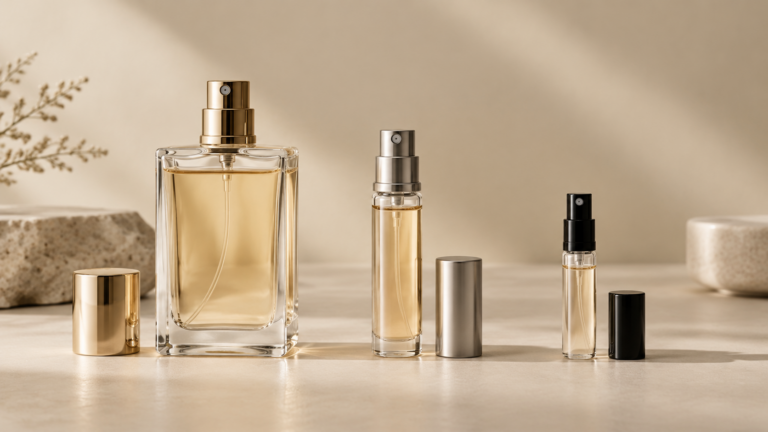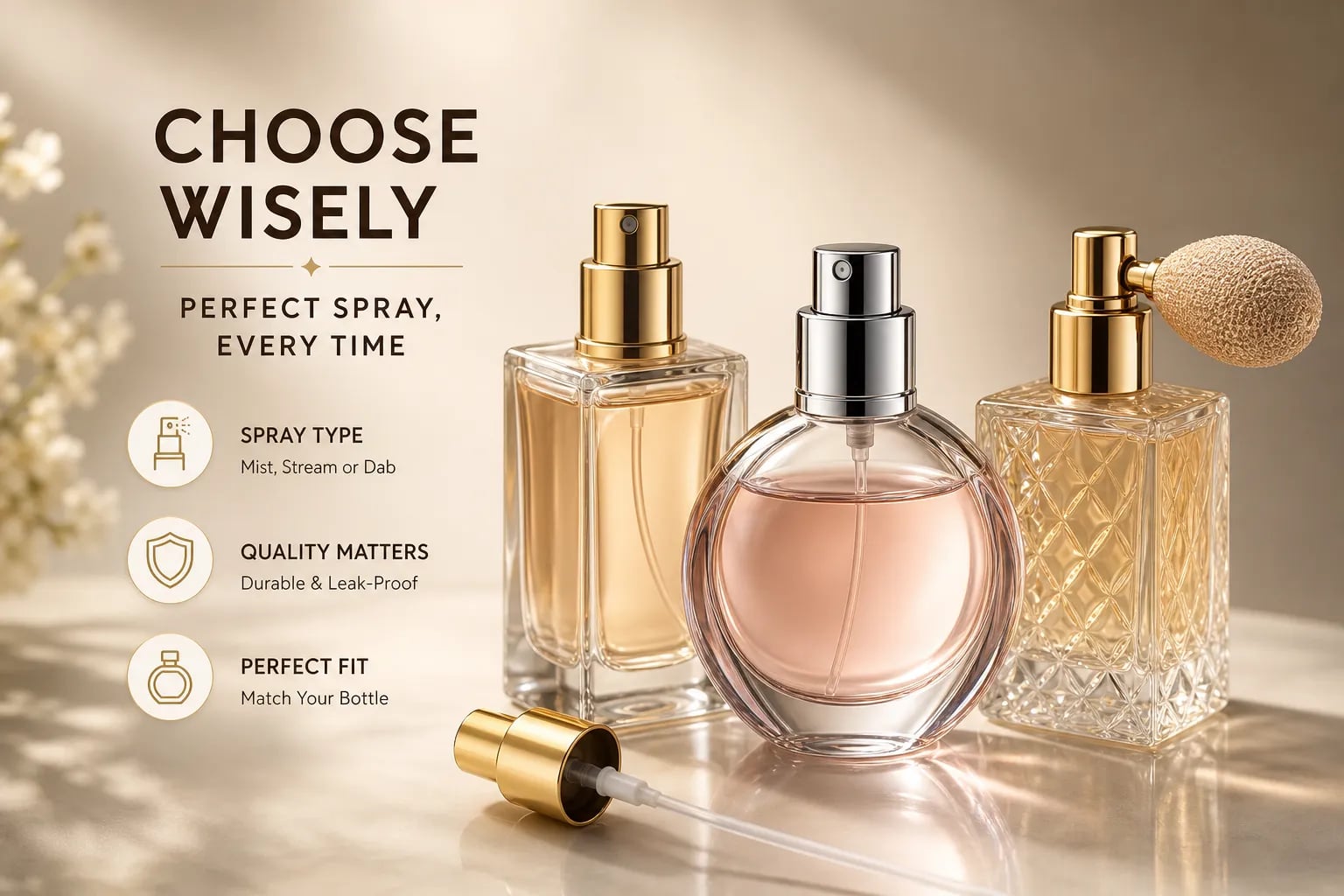
The right perfume bottle sprayer for your formula depends on viscosity, how precisely your customer needs to dose it, and how long it needs to stay stable after opening. For true fragrance, a fine-mist FEA crimp sprayer on a glass bottle is the standard choice. For serums or oils, a dropper gives you better precision and less air exposure. For facial mists or body sprays, a fine-mist sprayer is typically the right mechanism, it atomizes watery, low-viscosity liquids into a light, even cloud in a way that dip-tube or standard pump nozzles simply cannot.
Understanding why each mechanism works the way it does keeps you from making a costly mismatch between formula and package. This guide walks through all three dispensing formats so you can choose confidently, whether you’re building your first product line or expanding an existing one.
Key takeaways
- Formula viscosity decides first: Fine-mist perfume bottle sprayers only atomize low-viscosity, watery liquids. Thicker formulas need a pump; high-potency concentrates need a dropper.
- FEA sizing is non-negotiable: FEA 15 is the most common neck size for perfume bottles; FEA 18 and FEA 13 are also used. Replacement sprayer heads must match the exact designation, not just an approximate diameter.
- Glass remains the benchmark for fragrance: Amber or opaque glass blocks UV light and is chemically inert, which preserves fragrance integrity far better than clear glass or standard PET over time.
- Airless pumps cost more for a reason: They minimize oxygen exposure, which matters for antioxidant serums, retinoids, and oxidation-sensitive botanical extracts.
- Most sprayer failures are fixable: Clogged nozzles, air locks, and misaligned heads are among the most common perfume spray problems. Internal valve failures require a replacement head, not a repair.
- Test before you commit: Real-world testing on small batches reveals issues that a formula spec sheet never will, from clogging patterns to spray feel on skin.
Why your dispenser choice shapes the entire product experience
Most founders put real energy into bottle shape and label design, then treat the dispenser as an afterthought. That approach gets expensive fast. The mechanism you choose controls how much product reaches your customer per use, how much air enters the container after each application, and how consistently the formula performs from the first pump to the last drop.
Droppers, pumps, and sprayers each work on a different physical principle. A dropper uses capillary action and gravity to deliver a controlled drop. A pump creates suction through a metering chamber and dip tube. A sprayer forces liquid through a small orifice under pressure to break it into an airborne mist. The customer’s experience, whether that’s precise dosing, a silky spread, or an even fragrance cloud, follows directly from that underlying mechanism.
Dispenser type also connects directly to formula stability. Every time a customer uses a product, air or contamination can enter the container. Droppers and airless pumps minimize that exchange. Standard dip-tube pumps allow some air back in with each stroke. Conventional perfume sprayers use a one-way valve that limits, but does not fully eliminate, air contact. Matching the dispenser to the formula’s sensitivity is part of the packaging decision, not a separate one.
What a dropper bottle actually does for your formula
Dropper bottles are the right call for any formula that needs precise, small-volume dosing: facial serums, vitamin C treatments, botanical extracts, essential oil concentrates, and CBD products. These are typically low-viscosity, high-potency liquids where a few extra drops would either waste expensive actives or irritate skin. The dropper gives the customer full control over how much they use, which also reduces waste and extends the perceived value of the product. Note that for oxidation-sensitive actives like retinol, an airless pump may offer stronger preservation than a dropper by further limiting oxygen exposure.
A glass dropper pipette draws in only as much liquid as the customer needs, then reseals. This limits how often the bulk of the formula is exposed to outside air or bacteria from fingers. Amber and violet glass dropper bottles add an extra layer of protection by blocking UV light that can break down light-sensitive actives like vitamin C or certain botanical oils. Standard amber glass blocks roughly 90 to 98 percent of UV radiation, depending on glass composition and thickness, making it the strongest standard choice for light-degradable formulas.
Where droppers fall short is coverage and viscosity range. They are not suited for thicker creams or body washes, and they require dexterity that can be a barrier for some customers. If your formula needs to cover a full face or arm in seconds, a dropper will frustrate the end user before they even assess the formula itself. For wide-area application, a sprayer or pump is the better fit.
When a pump dispenser makes more sense than a sprayer
A dip-tube pump pulls liquid up from the bottom of the bottle with each press and dispenses a metered volume through the nozzle. This makes it ideal for thicker liquids: lotions, cleansers, conditioners, and body oils that are too viscous to atomize through a fine-mist nozzle. Dosing is consistent, waste is low, and the format works across a wide viscosity range. Pumps are commonly used for prestige skincare formats.
An airless pump uses a moving piston to push product upward instead of drawing it through a dip tube. No dip tube is needed, and a one-way valve seals the reservoir between uses. As a result, very little oxygen enters the container after each stroke. For formulas with active ingredients that degrade when exposed to oxygen, including antioxidant serums, retinoids, and peptide blends, this is a meaningful preservation advantage. The tradeoff is cost: airless pump bottles are more expensive per unit, and you need to match the piston tolerance carefully to your formula’s viscosity.
The one consistent weakness of pump formats is atomization. The nozzle opening and metering chamber volume are sized for liquids that flow, not for the micro-droplets that make a fragrance cloud or facial mist feel luxurious. A standard lotion pump on a watery fragrance or an alcohol-based mist produces a wet, uneven stream rather than a fine spray. For any formula meant to be misted, you need a perfume bottle sprayer.
How a perfume bottle sprayer works, and when it’s the right call
A perfume bottle sprayer forces liquid through a very small orifice, typically between 0.2 and 0.3 mm in diameter for fragrance pumps, under the pressure created by the pump stroke. That pressure breaks the liquid into tiny droplets that disperse into the air as a fine, even cone.
Orifice size and droplet quality
Fine-mist atomizer nozzles in this range typically produce droplets of 20 to 50 microns, compared to the larger, wetter output of a standard spray nozzle with an orifice of 0.5 mm or more. The quality of that mist cone also depends on swirl chamber geometry and how precisely the actuator is machined.
Perfume bottle sprayer sizing and FEA codes
FEA sizing matters enormously when sourcing replacement sprayer heads or ordering bottles and pumps separately. Most traditional glass perfume bottles use FEA crimp or snap-on necks, with FEA 15 being the most common size across the industry; FEA 18 and FEA 13 are also used. A crimp pump that is even slightly off in diameter will not seal correctly, leading to leaks, weak spray, or pump failure. Refillable or lower-cost formats may instead use threaded necks with thread codes like 18/400 or 24/410. These thread codes are not interchangeable with each other even when the outer diameter looks similar, for example, 24/410 and 24/415 are both 24 mm but have different thread profiles.
Any liquid meant to disperse into the air belongs in a sprayer: eau de parfum, eau de toilette, body fragrance, facial mist, setting spray, and room sprays. If the customer experience involves a sensory cloud, a gentle veil on skin, or a functional mist across a large surface area, a refillable perfume bottle fitted with a fine-mist sprayer is the mechanism that delivers it. For anything with higher viscosity, a pump is the better tool.
Does bottle material change how well your sprayer performs?
Glass is chemically inert, so it does not interact with alcohol-based fragrances or reactive botanical ingredients. It creates an excellent barrier against oxygen and does not allow volatile fragrance compounds to permeate through the wall over time. Clear glass still allows light exposure, so for light-sensitive formulas, amber or opaque glass is the better call. Glass also provides a rigid, stable platform for crimped pump fittings, which helps maintain seal compression and prevents the micro-leaks that degrade spray consistency over time.
Aluminum is lighter than glass and blocks both light and oxygen effectively, which is why it dominates the refillable travel atomizer market. The critical requirement is a chemically compatible interior lining or lacquer. An unprotected aluminum wall can corrode when exposed to alcohol-based fragrance, producing metallic odor, discoloration, or visible contamination. When the lining is intact and properly tested, aluminum is an excellent choice for travel formats.
PET plastic is lightweight, shatter-resistant, and less expensive than glass or aluminum, but standard PET allows some oxygen and volatile fragrance compounds to migrate through the container wall over months of storage. Opaque, multilayer, or metallized PET performs better than clear single-layer PET. For high-end fragrance meant to remain stable for a year or more, glass is the more reliable choice. For budget-friendly or promotional packaging with a shorter shelf window, PET with a high-quality low-ingress pump spray is a reasonable compromise.
Dropper vs. pump vs. sprayer: which one fits your formula?
The table below compares all three dispensing mechanisms across the factors that most directly affect your product’s performance and your customer’s experience. No single mechanism wins on every dimension, which is why matching the dispenser to your specific formula requirements matters more than picking a category default.
| Criteria | Dropper | Pump (dip-tube) | Pump (airless) | Perfume bottle sprayer |
|---|---|---|---|---|
| Best formula type | Serums, oils, concentrates, botanicals | Lotions, cleansers, thicker liquids | Oxidation-prone serums, retinoids, peptides | Fragrances, facial mists, setting sprays |
| Viscosity range | Low to medium | Medium to high | Low to medium | Low only |
| Air exposure per use | Very low | Moderate | Very low | Low (one-way valve) |
| Dosing precision | High (drop-level) | Medium (metered stroke) | Medium (metered stroke) | Low (mist pattern) |
| Preservation strength | High with UV glass | Moderate | High | Moderate |
| Customer experience | Tactile, precise | Smooth, efficient | Smooth, efficient | Sensory, aspirational |
| Ideal product category | Skincare actives, CBD, essential oils | Skincare, haircare, body care | Anti-aging serums, retinoids | Fragrance, body mist, facial mist |
Reading the table works best when you look at three or four criteria at once. If your formula is a 1% retinol serum in a botanical oil base, the airless pump column is the stronger fit: oxidation-sensitive actives benefit from minimal air exposure, and the metered stroke still delivers the dosing control that high-potency serums require. If you’re launching a facial mist with hyaluronic acid and rose water, the perfume spray pump column fits: watery formula, large coverage area, mist-delivery experience. A formula meant to preserve unstable vitamin C over a 12-month shelf life belongs in the airless pump column almost automatically.
One thing the table does not capture is the sensory story. A fine-mist sprayer produces an aspirational experience that a dropper simply cannot replicate, even if the underlying formula is identical. For fragrance and mist formats, that sensory dimension is part of the product itself, not just a packaging choice layered on top.
Perfume bottle sprayer troubleshooting
Most perfume sprayer failures trace back to one of four things: a clogged nozzle from dried fragrance residue, an air lock in the pump chamber, a loose or misaligned spray head, or a bent or detached dip tube. A worn pump valve or cracked stem gasket is less common but does happen with older bottles or low-quality replacement sprayer nozzles. Identifying the cause before reaching for tools saves time and avoids accidental damage to a glass bottle.
Start by holding the bottle upright and pressing the sprayer firmly 10 to 15 times to re-prime the pump. If that does not produce spray, remove the actuator button by pulling it straight upward and soak it in warm water for 5 to 15 minutes, do not submerge the entire bottle. Rinse the button, reattach it, and try again. For stubborn clogs, a 10-minute soak of the detached actuator in 70% isopropyl alcohol will dissolve most dried fragrance residue; then clear the nozzle orifice with a fine needle only as a last resort, since enlarging the orifice permanently ruins the spray pattern.
If the button feels spongy with no resistance, liquid leaks around the collar, or the bottle has never sprayed properly from new, the issue is inside the pump mechanism. These internal valve failures are not reliably fixable on a sealed retail bottle. The practical solution is to transfer the fragrance to a compatible refillable atomizer or replace the full pump assembly with a correctly sized replacement head. For a screw-on pump, removal is straightforward. For a crimped pump, you need the right crimping tool and an FEA-matched replacement, otherwise, the fragrance transfer option is simply easier.
Where indie brands source all three dispenser types without factory-scale minimums
Choosing between a dropper, a pump, and a perfume bottle sprayer is not always obvious from the formula spec sheet alone. Real-world testing matters: how does the spray pattern feel against skin, does the pump clog after 30 uses, does the dropper pipette seal cleanly after each drop? Many indie founders find that their first instinct on dispenser type changes after a single product photo shoot or a short batch of samples reaches real customers.
As a wholesale beauty packaging supplier, we carry more than 3,000 SKUs covering all three dispenser categories: dropper bottles in amber and violet UV-protective glass, airless and dip-tube pump bottles in glass and PET, and fine-mist spray bottles and perfume atomizers in multiple neck sizes. Global delivery and multi-currency pricing remove the friction for brands sourcing from outside the US as well.
Before placing any wholesale order, confirm the neck finish size on the bottles you are evaluating: FEA 15 crimp for most fine-fragrance formats, or a thread code like 24/410 for standard pump bottles. Match the replacement or new pump to that specification exactly, not approximately. Once you have tested the dispenser on a small batch and confirmed the spray pattern, the dosing feel, and the formula stability, scaling up with bulk pricing is straightforward. The early investment in format testing pays back in lower return rates, stronger reviews, and a product experience that holds up across the full life of the bottle.
Getting the decision right the first time
The perfume bottle sprayer is the right choice when your formula is meant to be misted: fine fragrance, facial mist, setting spray, or room spray. That choice only holds up in context. A dropper protects precision formulas better. A pump handles viscous products and oxidation-sensitive actives better. The material of the container either supports or undermines whatever dispenser you install, and amber glass remains the most reliable long-term option for light-sensitive formulas regardless of which dispenser sits on top.
For indie brands building out a product line, the most valuable move you can make before committing to a full production run is to test all three formats. Order a small batch of dropper bottles, pump bottles, and perfume bottle sprayers. Put your formula in each one and show them to real customers. What feels aspirational on your formulator’s bench does not always translate to what feels right in someone else’s hand.
We carry all three formats at BOBOPKG with the low MOQs that make that kind of testing practical for small brands. Get in touch with our team to request a catalog or talk through which formats are the best fit for your formula and your production volume. The right dispenser is out there, and it’s worth finding it before the labels are printed.
Frequently asked questions about perfume bottle sprayers
What is the difference between a perfume bottle sprayer and a regular spray pump?
A perfume bottle sprayer uses a very small orifice, typically 0.2 to 0.3 mm, to atomize low-viscosity, alcohol-based liquid into a fine mist cone of 20 to 50 microns. A regular spray pump has a larger orifice (0.5 mm or more) and produces a wetter, less refined output suited to thicker liquids like cleanser or hair spray. The two are not interchangeable.
Can I use a perfume spray pump on any bottle?
Only if the neck finish matches exactly. Most fine-fragrance glass bottles use FEA 15, FEA 18, or FEA 13 crimp necks. Standard lotion and skincare bottles use threaded finishes such as 24/410 or 18/400. A perfume spray pump designed for one finish will not seal correctly on another, even if the outer diameter looks close.
When should I use a refillable perfume bottle instead of a single-use bottle?
A refillable perfume bottle makes sense for travel formats, sampling programs, or sustainability-focused lines. The key requirement is a compatible refillable atomizer mechanism and a bottle material, typically aluminum or glass, that can be cleaned and refilled without degrading the interior surface or the pump mechanism.
What causes a replacement sprayer nozzle to stop working?
The most common causes are dried fragrance residue clogging the orifice, an air lock in the pump chamber, and an incorrectly sized or misaligned replacement sprayer nozzle. Internal valve or gasket failure is less common but requires a full pump replacement rather than a cleaning fix.
Is a perfume bottle sprayer suitable for thick serums or oils?
No. Fine-mist perfume bottle sprayers are designed for watery, low-viscosity liquids. Thicker serums and oils will clog the small orifice quickly or fail to atomize at all. For those formulas, a dropper or pump dispenser is the correct choice.