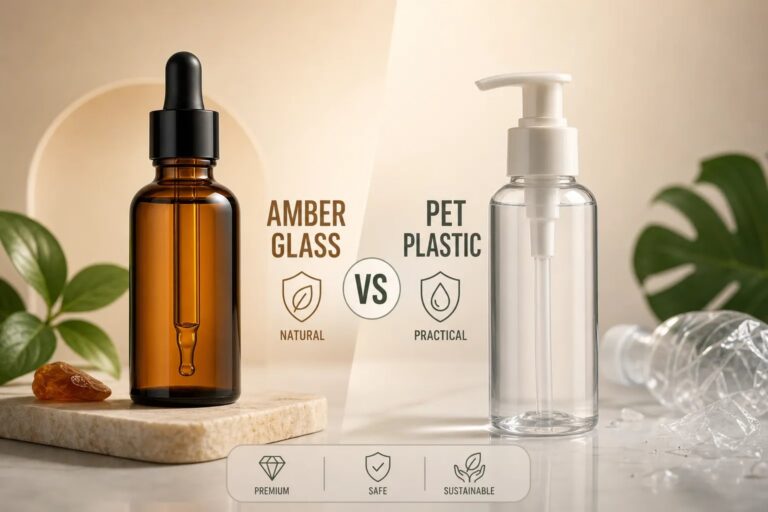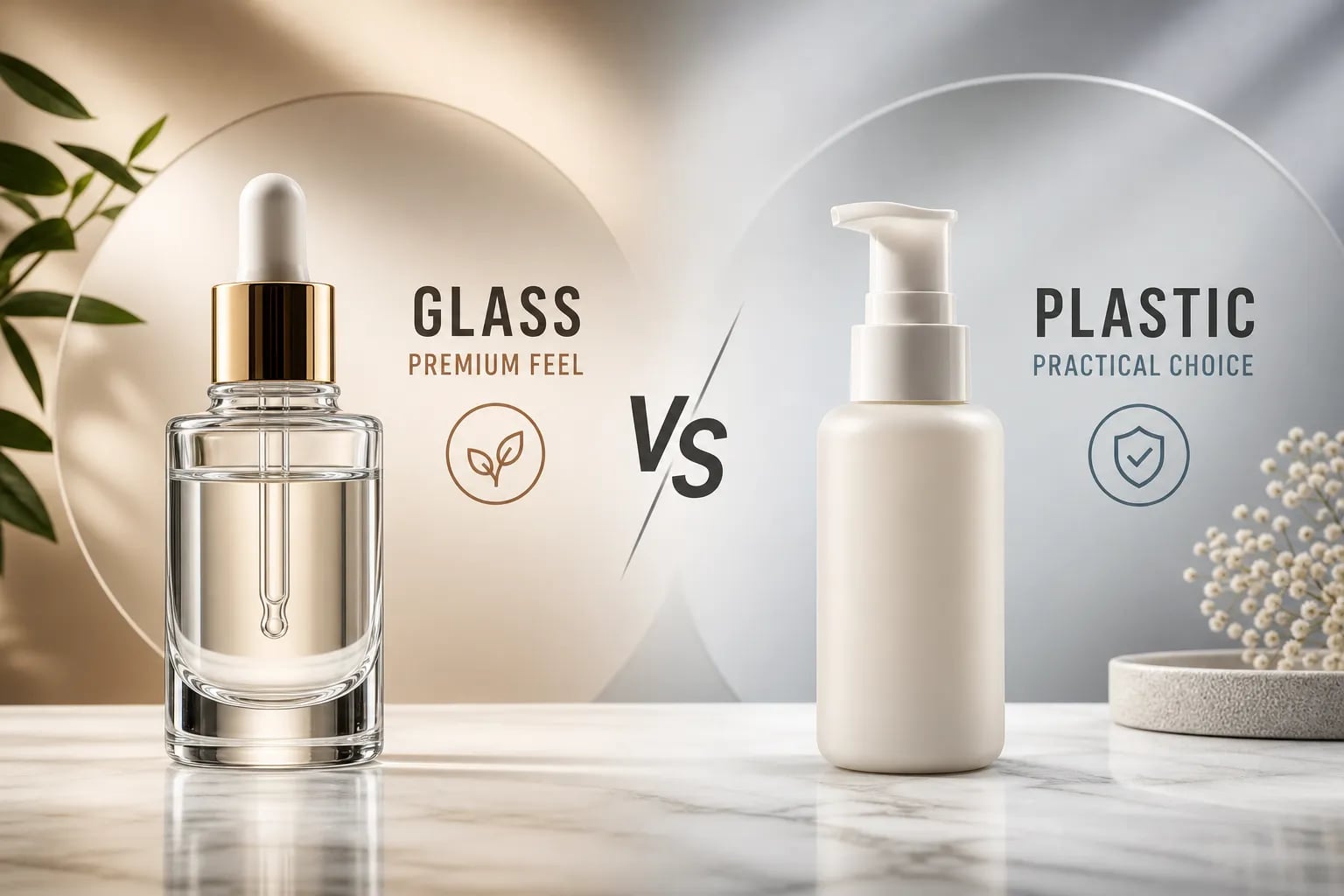
Choosing between glass vs. plastic cosmetic bottles depends on your formula, price point, and logistics, and neither material is universally better. Glass wins for premium brand positioning, formula preservation, and oxidation-sensitive products. Plastic wins for cost control, shipping weight, and high-volume everyday formulas. The right call comes down to four things: what’s in your bottle, who’s buying it, what you’re charging for it, and how it’s getting to your customers.
The answer is almost never obvious from the outside, which is why we’ve put together this guide to work through each deciding factor in practical detail. By the end, you’ll have a clear framework for matching material to formula, price point, and logistics.
The worst thing you can do is choose packaging on instinct. The second worst is choosing based on aesthetics alone. Both of those paths lead to compatibility failures, logistics surprises, and sustainability claims you can’t back up. Here’s how to get it right.
Points clés à retenir
- Glass for actives and premium positioning: Formulas with vitamin C, retinoids, essential oils, or volatile fragrances belong in glass. It offers near-total barrier performance and chemical inertness that plastic can’t match.
- Plastic for scale and logistics: PET and HDPE are the right call for cleansers, body lotions, shampoos, and any product that ships often or gets used in the shower.
- Cost gap is real and wide: At 500–5,000 units, glass typically runs $1.20–$4.50 per bottle versus $0.45–$1.50 for plastic, and shipping adds even more, according to Alibaba’s B2B packaging selection guide.
- Single-use glass isn’t automatically greener: Lifecycle assessments consistently find that single-use plastic has lower greenhouse gas emissions than single-use glass. Refill systems change that math.
- Testez avant de valider : Run both candidates through accelerated stability with your actual formula before finalizing your production order.
- Low MOQ sourcing makes testing practical: Suppliers like BOBOPKG offer stock glass and PET containers at low minimums so you can run parallel tests without a factory-scale commitment.
When glass earns its place (and when it doesn’t)
Glass is the right call in these situations
Glass earns its place when your formula needs maximum protection against oxygen, light, and chemical interaction. UV-sensitive serums with vitamin C or retinoids, essential oil blends, volatile fragrances, and high-potency botanical extracts all benefit directly from glass’s chemical inertness. There’s virtually no risk of ingredient migration or fragrance sorption into the container walls, which means your formula stays exactly as you made it for longer.
Glass also carries a brand story that plastic can’t replicate at the same price point. Amber and violet glass add a second layer of value on top of inertness: amber glass commonly blocks about 90% of UVA in the 320–400 nm range, according to Lansenpack, making it specifically suited for oil-based formulas and botanical extracts that degrade under store lighting.
Plastic is the smarter pick more often than people think
“Plastic” is not a single material, and treating it as one is one of the most common mistakes small brands make. PET provides good clarity and a solid barrier for most conventional cosmetic formulas. HDPE handles moisture-rich products reliably and resists a wide range of chemicals. The right plastic, properly tested, is not a compromise. It’s a decision.
High-volume cleansers, body lotions, shampoos, and travel-size formats belong in plastic. Products that ship frequently, get used in showers, or live in gym bags need containers that won’t shatter. For these categories, PET or HDPE isn’t a downgrade. It’s the right engineering decision for the use case, and your customers will thank you for it every time they pick up a slippery bottle without worrying about it hitting the tile.
How each material actually protects your formula
Glass: near-perfect barrier, but the bottle isn’t the whole system
Glass is essentially impermeable to oxygen, water vapor, and fragrance vapors. It’s nonporous and chemically inert, meaning it won’t react with aggressive actives, solvents, or high-pH formulas. Clear glass offers virtually no UV protection on its own, but amber or cobalt glass blocks light effectively for formulas that need it, according to Global Formulation’s compatibility testing guidance.
The critical nuance is that the glass bottle is only one part of the system. The pump, liner, closure, and any decorative coating all carry their own compatibility risks and must be tested together with your formula. A perfectly inert glass bottle fitted with an incompatible pump liner can still compromise what’s inside. Test the complete system, not just the vessel, before you approve a production run.
Glass vs. plastic cosmetic bottles: what PET and HDPE protect and where they fall short
PET’s strengths are real: good clarity, a decent oxygen barrier for most cosmetic formulas, and compatibility with a wide range of products including alcohol-containing and surfactant-based formulations. The caveats are equally real. High-solvent formulas, aggressive actives, and some fragrances can cause stress cracking or ingredient sorption in PET, according to Global Formulation. These aren’t hypothetical risks. They show up in stability testing when brands skip the compatibility step.
HDPE handles lotions and cleansers well but is more permeable to fragrance compounds than PET. The conclusion from all of this isn’t “plastic is worse.” It’s “know your formula and test before you commit to a run.” A solid PET serum bottle with an airless pump can outperform a clear glass bottle with a standard dropper for many formulas, especially where oxygen exclusion matters more than UV protection.
Glass vs. plastic cosmetic bottles: cost and shipping
Per-unit cost at different order volumes
The cost difference between glass and plastic is consistent and significant. At 5,000–25,000 units, those ranges shift to $1.00–$3.25 for glass and $0.35–$1.00 for plastic, according to Alibaba’s B2B packaging selection guide. These are planning estimates for a roughly 30–50 mL bottle including basic decoration and a breakage allowance, before closures, filling, cartons, or duties.
Tooling costs follow the same pattern. Basic plastic molds run approximately $500–$1,800, while glass molds typically start around $800–$2,500, according to Lisson Packaging. The ratio between materials narrows at higher volumes as tooling costs amortize across more units, but plastic remains consistently cheaper at every scale. Use these numbers as planning anchors before you request a quote.
The costs most brands forget to budget
The per-unit price gap is only part of the real cost story. A same-volume glass bottle can weigh 6–10 times more than its PET equivalent, according to Propacks, which drives up shipping costs on every order sent to your fulfillment center and every package shipped to a customer. Glass production and shipping loss runs at 3–5% versus under 1% for plastic, according to Alibaba’s selection guide. Add protective secondary packaging and inserts, and the total landed-cost difference grows well beyond what the bottle price comparison shows.
For small-batch U.S. fulfillment, glass typically costs about $1.50–$4 more per customer order to ship than an equivalent PET bottle, according to Propacks and Packfolio. For a brand moving 500–2,000 units through direct-to-consumer channels, those shipping and protection costs can exceed the bottle price difference on their own. Build that into your unit economics before you choose your material, not after.
Is glass packaging actually better for the environment?
What lifecycle assessments actually say
This is where the conventional wisdom breaks down. Lifecycle assessments consistently find that single-use glass does not have lower lifecycle greenhouse gas emissions than single-use plastic. Glass melting is energy-intensive, and the material’s weight dramatically increases transport emissions at every point in the supply chain. According to PMC research and a comparative study published in Springer, non-returnable glass often performs worse on climate impact than virgin PET.
The recyclability gap between the two materials is real. According to BBC reporting, glass is recycled at roughly 76% in Europe versus about 41% for plastic packaging. But higher recyclability rates don’t fully offset the energy difference in manufacturing and transport for single-use formats. Recycled PET typically performs best across lifecycle impact categories. If you’re choosing glass for environmental reasons on a single-use product, the lifecycle data doesn’t support that claim as clearly as the packaging aesthetics might suggest.
Where glass actually holds up on sustainability
Glass genuinely outperforms plastic when it enters a real refill or return system with high return rates, multiple genuine reuse cycles, short distribution distances, and efficient washing. A Norsus review of lifecycle assessments found the break-even point for reusable glass at around 2–3 genuine use cycles versus some single-use alternatives. The emphasis belongs on “genuine”: a glass bottle designed to be refillable that gets thrown away after a single use delivers none of the environmental benefit the design implies.
The practical implication for brands is straightforward. If you’re not running a verified take-back program, calling glass the “eco” choice needs a closer look. Lightweight recycled PET used once and properly recycled may carry a lower environmental footprint than a heavy glass bottle that ends up in the trash. Make sustainability claims you can actually stand behind, because a lifecycle analysis will catch the ones you can’t. For brands exploring sustainable cosmetic packaging, the material choice matters far less than the end-of-life system you build around it.
Does glass packaging actually make your product sell better?
Why glass commands a higher price in premium beauty
Consumer research consistently shows that glass carries higher perceived value than plastic in beauty and skincare. Survey findings from Alibaba’s strategic fragrance packaging guide and Reports and Data market research report that roughly 60–73% of consumers view glass as more sustainable or premium. A German conjoint study found that consumers placed a positive value of roughly €1 on glass versus a study baseline, according to an MDPI study on green cosmetics and consumer packaging behavior.
Glass works hardest in serums, anti-aging treatments, facial oils, and fragrance because it reinforces sensory expectations before the formula even touches skin. Weight, transparency, the sound of a glass dropper, the feel of a heavy cap: all of it signals quality. Brands using glass in premium skincare can support 20–50% higher retail prices when the full brand positioning backs it up, according to Dataintelo’s personal care packaging market research. For an indie brand building margin from the first batch, that’s not a trivial pricing lever.
Where plastic is the smarter consumer-facing choice
Plastic wins on convenience, durability, and affordability perception for mass-market categories. Body lotions, shampoos, and everyday cleansers in glass bottles create real friction: breakage in the shower, heavier shipping, harder to squeeze when the formula gets low. For these categories, a well-branded PET bottle or frosted HDPE container with strong label design outperforms glass on practical consumer value every time.
The market data reflects this clearly. Rigid plastic accounts for roughly 35.8% of personal-care packaging value versus about 18.2% for glass, according to Dataintelo’s personal care packaging research. That ratio exists for good commercial reasons: the categories where consumers buy the most volume are exactly the ones where plastic’s practical advantages dominate. Recycled PET and bio-based plastics are also closing the sustainability perception gap as consumer education improves, which reduces one of glass’s remaining advantages in mass-market positioning.
Glass vs. plastic side by side: a quick-reference breakdown
| Critère | Verre | PET plastic | HDPE plastic |
|---|---|---|---|
| Chemical inertness | Excellent: nonporous, no leaching or sorption | Good: compatible with most cosmetics; some solvents can cause stress cracking | Good: strong general resistance; fragrance compounds may sorb |
| Barrier performance | Excellent: nearly impermeable to oxygen, water vapor, fragrance | Good: solid barrier for most formulas; not absolute | Moderate: strong moisture resistance; more permeable to oxygen and fragrance |
| Poids | Heavy: ~6–10x heavier than equivalent PET | Lightweight | Lightweight |
| UV protection | Amber/cobalt: strong. Clear glass: none | None without UV additives or opaque pigment | None unless pigmented or UV-treated |
| Consumer perception | Premium, luxury, pure | Neutral to functional; improving with recycled content | Functional; less premium signal |
| Sustainability (single-use) | Lower: energy-intensive production, heavier transport emissions | Better than glass on lifecycle GHG for single-use formats | Similar to PET; recycled content reduces impact significantly |
| Recyclabilité | High collection rates where infrastructure exists; can be recycled indefinitely | Recyclable; pumps and multi-component closures reduce actual rates | Recyclable; actual rates vary by region and program |
| Breakage risk | 3–5% production/shipping loss | Under 1% | Under 1% |
| Best product fits | Serums, face oils, essential oils, vitamin C, retinoids, premium botanicals | Cleansers, toners, shampoos, travel formats, mass-market skincare | Body lotions, body washes, shampoos, cleansers |
How to use this table with your actual product
The table gives you a fast scan, but the real decision happens in sequence. Start with your formula type: oil-based, active-heavy, or volatile? Glass goes to the top of the list. Water-based, surfactant-forward, or high-volume? Plastic is likely the smarter call. For lower price tiers, plastic often performs well on margin and logistics; at higher price tiers, glass tends to support both the margin and the positioning story.
Finally, look at your order volume. For smaller runs, starting with stock plastic lets you test before taking on the cost and logistics complexity of glass. Run both materials through your actual formula before committing to a full production run. Assumptions about compatibility are not a substitute for stability data, and the table tells you where to start, not where to land.
What U.S. brands need to know about safety and compliance
What the FDA actually requires from your packaging
FDA does not issue a general “approved packaging” list or a universal migration limit for cosmetics. The standard, under the Federal Food, Drug, and Cosmetic Act, is that your complete container-closure system must not adulterate, contaminate, or misbrand your product. You’re responsible for substantiating safety, and FDA’s GMP guidance for cosmetics expects primary packaging to be stored and handled to prevent both microbial and chemical contamination.
Labeling requirements apply regardless of material. Your outer package must include product identity, accurate net quantity of contents, ingredient declaration in descending order of predominance, manufacturer name and address, and any required warnings, all displayed prominently and conspicuously according to FDA’s labeling regulations and the Fair Packaging and Labeling Act. These requirements apply equally whether your formula is in glass or in plastic.
Compatibility testing before you commit to a material
This is the step most indie brands skip, and it’s the most important one. Testing means filling your actual formula into the final bottle, pump or dropper, liner, and closure together, not just the bottle. Accelerated stability studies, weight loss checks, color and odor evaluation, active-content assay, and container integrity checks are the baseline for any responsible launch, according to Global Formulation’s packaging compatibility guidance.
For plastic, watch for stress cracking, fragrance sorption, and migration under worst-case conditions including heat, high pH, oily formulas, and high-alcohol content. For glass, check coatings, adhesives, metal components, and any decorative finishes for their own compatibility with your formula. Don’t assume that food-safe plastic automatically qualifies for your cosmetic formula. FDA does not treat food-contact clearance as a proxy for cosmetic suitability, and the exposure conditions, contact time, and formula chemistry may differ substantially from food applications.
How to source both glass and plastic without overcomplicating it
What to look for in a packaging supplier at any order volume
When choosing between glass vs. plastic bottles for cosmetics, the sourcing criteria that matter most are stock availability in both glass and PET formats, low MOQ options that let you test before you commit, clear specifications on fill volume and compatible closures, and reliable lead times. Sourcing glass and plastic from a single supplier simplifies ordering and makes it much easier to run parallel tests on the same formula in different materials without managing two sets of freight, lead times, and supplier relationships.
That’s exactly what we’ve built at BOBOPKG. Our catalog includes 3,000+ SKUs spanning amber and violet glass bottles, PET and HDPE plastic containers, airless pumps, dropper systems, foam pumps, spray bottles, and more. Low MOQs are central to how we work: indie brands and small businesses can order in manageable quantities without a factory-scale commitment, which means you can compare materials in your actual formula before you’re locked into thousands of units of the wrong bottle.
Starting with low MOQ to test before you scale
The practical launch sequence is straightforward. Identify two candidate bottles, one glass and one PET, that fit your formula’s fill volume and dispensing needs. Order a sample quantity from a supplier that supports low-lot purchasing. Run your stability tests in both containers simultaneously. Industry practice for accelerated stability screening commonly runs 8–12 weeks, though a shorter window can serve as an early indicator; plan your timeline accordingly. Evaluate whether the formula stays stable in each material, whether the material affects color, scent, or texture, and whether the bottle feels right for your target retail price point.
Then commit to a larger production run with full confidence in your material choice. The worst outcome in cosmetic packaging is sitting on 10,000 units of the wrong bottle because you skipped the test run. Low MOQ sourcing removes that risk entirely, and it’s the reason we keep our minimums accessible for brands at every stage of growth.
Making the call on glass vs. plastic cosmetic bottles
Choosing between glass and plastic cosmetic bottles isn’t a values question. It’s a formula, brand, and budget question. Glass earns its place for premium actives, UV-sensitive ingredients, and high-margin positioning where the packaging reinforces what’s inside the bottle. Plastic earns its place for affordability, logistics efficiency, scale, and everyday consumer categories where convenience and durability matter more than shelf presence.
Skipping compatibility testing after making an instinct-based pick is the most expensive mistake in cosmetic packaging. A bottle that looks perfect on your brand board can still fail your formula under accelerated stability, and discovering that after a production run is an expensive lesson. The best decision is running both materials through your actual formula, in the actual bottles you plan to use, before committing to the run.
When you’re ready to start comparing candidates, browse BOBOPKG’s catalog of glass and plastic cosmetic containers. We carry both materials across a wide range of fill volumes, closure types, and dispensing formats, all with low MOQs that make parallel testing practical at any stage of your brand’s growth. Get in touch with our team to find the right options for your formula and your budget.
Questions fréquemment posées
Le fait d'opter pour le verre rendra-t-il automatiquement notre produit plus respectueux de l'environnement ?
Non, le verre à usage unique n'est pas automatiquement plus écologique que le plastique à usage unique. Les analyses du cycle de vie citées montrent que le verre à usage unique génère souvent davantage d'émissions de gaz à effet de serre que le PET à usage unique, car la fusion du verre est très gourmande en énergie et son transport, plus lourd, augmente les émissions ; le verre ne surpasse le plastique que lorsqu'il s'inscrit dans un système vérifié de recharge ou de consigne comportant plusieurs cycles de réutilisation réels.
Pouvons-nous nous approvisionner en verre et en plastique auprès du même fournisseur afin de simplifier les tests et les commandes ?
Oui, le fait de s'approvisionner auprès d'un seul fournisseur pour ces deux matériaux simplifie les commandes et les essais en parallèle. Notre catalogue comprend plus de 3 000 références, notamment en verre ambré et violet, en PET et en PEHD, ainsi que divers types de bouchons, avec des quantités minimales de commande (MOQ) réduites. Vous pouvez ainsi réaliser des essais de stabilité en parallèle sans avoir à gérer séparément le transport, les délais de livraison et les relations avec les fournisseurs.