Glass jars for cosmetic creams can be a useful option when users need to scoop a thick cream, balm, or body butter and the complete pack works with the formula. The decision depends on more than the glass body: check the lid, liner, fill volume, repeated opening, and shipping conditions before committing to a bulk order.
For a new cream SKU, start with the formula and application method, then shortlist a jar from the available cosmetic packaging options. A product listing can identify a candidate; filled samples are needed to evaluate whether it fits your product.
When does a glass jar fit a cosmetic cream?
A jar is worth evaluating when the product is intended to be scooped rather than poured or dispensed in drops. Think about how the cream behaves at filling, storage, and use temperatures. A texture that feels firm at room temperature may behave differently during filling or transport.
| Product or requirement | Why evaluate a jar? | What to check before choosing it |
|---|---|---|
| Scoopable cream, balm, or body butter | The opening gives users access to the product without drawing it through a dispensing mechanism. | Opening dimensions, access near the bottom, filling behavior, and lid clearance. |
| Cream sample or discovery size | A small jar can provide a format for a trial portion. | Actual fill weight, label area, closure fit, and intended application method. |
| Product sensitive to repeated exposure during use | A jar may still be possible, but the exposure needs evaluation. | Formula stability and microbiological safety under the intended use conditions; compare a dispensing pack if needed. |
| Lightweight or frequent-travel pack | Glass may meet the design brief, but transport suitability needs checking. | Filled pack weight, protective packing, breakage, and leakage with the selected closure. |
There is no single viscosity cutoff that makes every cream suitable for a jar or a pump. Ask the filler to assess the actual formula and filling process. For a pourable facial oil or serum rather than a scoopable cream, compare dropper bottle options and test dispensing with that formula.
When should you consider another format?
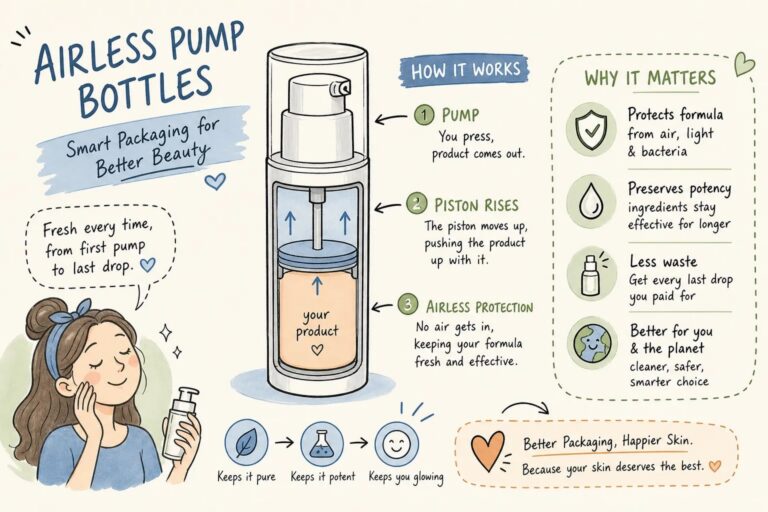
Consider a dispensing pack when the brief calls for controlled delivery or reduced direct hand contact with the stored product. That is a reason to compare formats, not evidence that a particular pump will dispense your cream correctly or preserve it for a stated period.
Die FDA’s guidance on microbiological safety identifies inadequate packaging protection and consumer use, including dipping fingers into a product, as possible sources of contamination. A spatula can support the intended application method, but does not replace appropriate formulation, preservation, manufacturing, or safety evaluation.
If your formula needs protection from light or repeated opening, ask the formulator to evaluate the complete pack. A black or frosted appearance is not, by itself, evidence of a measured UV barrier or a longer shelf life.
How should you check fill volume and headspace?
Start with the intended net fill and the formula’s measured density. A jar option labeled in grams should not be assumed to have the same numerical capacity in milliliters. Request the usable fill volume, brimful capacity, and dimensions for the exact option you want to sample.
Headspace is the space left above the filled product. Check it with the actual lid, liner, inner disc, or insert fitted. The product should not interfere with closure seating at the planned fill, and the appearance should meet the brand’s brief after settling and handling.
- Record the target net fill and how the filler will control it.
- Trial-fill the selected jar with the actual formula and production-relevant equipment.
- Check whether product reaches the sealing surface or lid during filling and handling.
- Inspect the filled pack after the storage and transport conditions chosen for the product.
Agree the acceptable fill range and headspace with the filler and packaging supplier. Do not apply a universal headspace percentage or hot-fill temperature to an untested jar assembly.
Which parts of the jar need compatibility testing?
Evaluate the complete assembly, including any plastic insert, lid, liner, seal, or decoration that may contact the formula. A glass outer body does not establish what every product-contact component is made from.
Die 2004 Cosmetics Europe/CTFA stability-testing guidelines include compatibility between the contents and container and recommend testing packaging as close as possible to the marketed pack. Use the guidance as a starting point for a product-specific evaluation with your formulator or testing laboratory.
- Formula condition: inspect the relevant changes in appearance, odor, texture, separation, and other parameters selected by the formulator.
- Closure performance: check seating, opening and closing, leakage, and interaction with the product.
- Pack condition: inspect relevant changes in inserts, liners, coatings, and labels.
- Verkehr: evaluate the filled pack with its proposed carton and protective packing.
The testing team should set the conditions, duration, sample count, and acceptance criteria for your product. A catalog description such as âleak-proofâ or ârefillableâ does not establish that your filled pack has passed those checks.
Two listed glass jar options to request as samples
The following BOBOPKG listings are starting points for selection. Their published names and option labels identify the packs; they do not certify compatibility with your cream.
| Listed option | Published specification labels | Sample questions |
|---|---|---|
| Black glass cosmetic jar for cream or body butter | 20g and 50g; black. | Confirm product-contact materials, insert construction if applicable, usable volume, and closure components. Request supporting data before making light-protection claims. |
| Frosted glass sample jar | 10g, 15g, and 20g; several listed cap finishes. | Confirm the selected finish and lid assembly, fill volume, label area, and filled-pack leakage performance. |
For a wider comparison of cream containers, browse the skincare packaging range. Select samples by formula and application requirements before deciding on color or decoration.
What should a bulk quote include?
Send the supplier the intended product type, target fill, selected jar option, filling method, quantity, decoration brief, and destination. Identify whether the quote includes the lid, liner, insert, seal, individual box, and outer carton.
Ask for the minimum order quantity for the exact assembly and finish, sample availability and cost, production lead time, and shipping terms. Stock packaging and custom decoration may have different ordering requirements. Obtain a current quote rather than assuming a displayed pack quantity is a universal MOQ.
Request a cream jar sample and bulk quote with your fill target and shortlisted option. Review sample results and agree the final assembly before placing the production order.
Häufig gestellte Fragen
Is glass always better than plastic for a cream?
No. Choose according to formula compatibility, application, filling, pack weight, and transport requirements. Test the actual assembly rather than treating its main material as a guarantee.
Can a 50g jar hold 50ml of cream?
Not necessarily. Grams describe mass and milliliters describe volume. Confirm the jar’s usable capacity and the formula’s density, then trial-fill it at the intended net weight.
Does a black glass jar guarantee UV protection?
No measured protection can be inferred from the color label alone. Request relevant light-transmission information and evaluate the product in its final pack if light sensitivity matters.
Can a refillable jar be reused without further checks?
A refillable listing does not validate a cleaning method or refill system. Confirm the construction and evaluate the proposed cleaning, refilling, closure wear, and microbiological controls before making reuse claims.