مورد زجاجات بمضخة سعة 100 مل: الحد الأدنى للطلب، مهلة التسليم، المعايير
When sourcing packaging, the 100ml Pump Bottle supplier MOQ (Minimum Order Quantity) is the primary pivot point between a successful product launch and a procurement bottleneck. Data indicates that approximately 65% of mid-market cosmetic brands face delays of 4-6 weeks due to misaligned MOQ expectations during the sampling phase. For a 100ml capacity—a high-demand volume that aligns with TSA travel regulations—benchmarks typically range from 1,000 units for stock items to 10,000+ units for custom-molded PET solutions. Navigating these tiers requires a rigorous understanding of unit cost amortization, lead time variance, and the technical specifications of the pump mechanism itself.
A standard 100ml PET foam bottle with a 30mm or 42mm neck finish generally sees a 15-22% reduction in unit cost when moving from an MOQ of 3,000 to 10,000 units. If your initial forecast is under 2,000 units, prioritize suppliers offering “off-the-shelf” stock with modular pump color options to avoid high tooling surcharges.
How buyers shortlist foam bottle options
Shortlisting a زجاجة رغوية supplier requires more than a price check; it demands a technical evaluation of the air-to-liquid ratio and the durability of the spring mechanism. Buyers must determine if the product requires a standard lotion pump or a specialized foamer pump, which utilizes a mesh screen to aerate the formula.
Which foam bottle options fit different filling and branding needs?
The selection process should be dictated by the viscosity of your formulation and your target retail price point. In the 100ml segment, buyers typically choose between three primary configurations:
- Standard PET Foamers: Ideal for face washes and hand sanitizers. These are lightweight, recyclable, and offer high clarity (90%+ transparency), allowing the product color to serve as a branding element.
- Opaque HDPE Options: Best for clinical or pharmaceutical-grade products where UV protection is necessary to prevent active ingredient degradation.
- Modular Pump Assemblies: Buyers looking to differentiate often shortlist suppliers who can swap the actuator or over-cap color without requiring a full custom mold.
What should buyers confirm before requesting quotes?
Before engaging a 100ml Pump Bottle supplier MOQ discussion, procurement teams must validate the following data points to ensure quote accuracy:
- Neck Finish Compatibility: Ensure the pump (e.g., 28/410 or 30mm) matches the bottle thread precisely to prevent 0.5%–1.5% leakage rates during transit.
- Dosage Output: Standard 100ml pumps usually deliver 0.4cc to 1.5cc per stroke. A mismatch here leads to poor user experience and wasted product.
- طول أنبوب الغمس: A dip tube that is 2mm too short results in “dead volume” at the bottom of the bottle, leading to negative consumer reviews.
موك والمهلة الزمنية ونقاط فحص العينة للزجاجة الرغوية
The relationship between MOQ and lead time is non-linear. While a stock order might ship in 7 days, a custom-colored 100ml bottle often requires a 35-day production cycle plus shipping. Understanding these benchmarks is critical for inventory management.
Comparison: Stock vs. Custom Order Implications
| الميزة | Stock (Off-the-Shelf) | Custom Production |
|---|---|---|
| موك النموذجي | 500 – 2,000 units | 5,000 – 20,000 units |
| المهلة الزمنية | 3 – 10 business days | 30 – 50 business days |
| Color Options | Limited (Clear, White, Amber) | Full Pantone Matching |
| تكلفة الوحدة | Higher (Premium for flexibility) | Lower (Volume discounts) |
مصادر الإشارات الحمراء والتحقق من المصادر
When evaluating a 100ml Pump Bottle supplier MOQ, watch for these technical red flags that indicate a low-quality manufacturing process:
- سمك الجدار غير المتناسق: If the PET weight for a 100ml bottle drops below 18-20 grams, the bottle may collapse under the vacuum pressure of the pump.
- Vague Sample Policies: Reliable suppliers should provide “golden samples” that represent the actual production run. If they only offer generic samples, the risk of “bait and switch” on material quality increases.
- Lack of Stress Crack Testing: For formulations containing essential oils, ensure the supplier has performed ESCR (Environmental Stress Crack Resistance) testing.
Specification and sourcing trade-offs for 100ml Pump Bottle supplier MOQ
Every procurement decision involves a trade-off between aesthetics, functionality, and cost. In the 100ml pump category, these trade-offs are often centered around material choice and closure mechanics.
Material and Compliance Trade-offs
While PET is the industry standard for clarity, many brands are moving toward rPET (recycled PET) to meet sustainability targets. However, rPET often carries a 15-25% price premium and may have a slight yellow or grey tint. Buyers must decide if the brand equity of “recycled packaging” outweighs the aesthetic cost of reduced clarity.
Furthermore, if your product is a high-potency serum, you might consider a dropper bottle 2oz(60ml) options as a secondary SKU. While 100ml is the “hero” size, smaller volumes often allow for higher price-per-ml margins and lower total MOQ barriers for market testing.
The “Total Cost of Ownership” Framework
When comparing quotes, use this weighted framework to evaluate suppliers:
- Quality Control (40%): Does the supplier use automated optical inspection for neck threads?
- Logistics (20%): Are the 100ml bottles shipped in nested trays to prevent scratching, or bulk-bagged (which increases scrap rates by 3-5%)?
- Technical Support (20%): Can the supplier provide CAD drawings for your label designer to ensure 100% wrap-around accuracy?
- Price (20%): Is the quote inclusive of duties, taxes, and “last-mile” delivery?
أمثلة على المنتجات المعينة وسيناريوهات الملاءمة
To ground these procurement benchmarks, let’s look at how specific 100ml configurations serve different market segments. These examples represent the core catalog of professional foam bottle solutions.
1. The Minimalist Professional: White Pump/White Lid
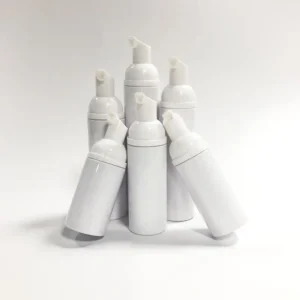
إن 30ml 60ml 100ML White pump white lid Plastic Foam Bottle is the “safe” choice for clinical skincare.
- Fit Scenario: Dermatological cleansers or medical-grade hand soaps.
- Why it works: The all-white assembly suggests purity and hygiene. The PET material provides the necessary chemical resistance for surfactant-heavy formulas.
2. The Modern Contrast: Black Pump/White Lid
إن 30ml 60ml 100ML White black pump white lid Plastic Foam Bottle offers a higher perceived value through visual contrast.
- Fit Scenario: Men’s grooming lines or premium “industrial-chic” lifestyle brands.
- Why it works: The black pump masks any potential product residue or staining that can occur with darker liquid formulas (e.g., charcoal-based cleansers).
3. The Niche Aesthetic: Pink Pump/White Lid
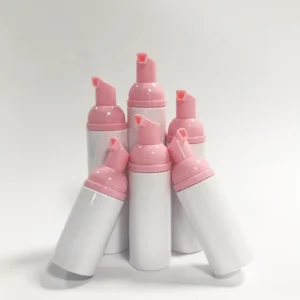
إن 30ml 60ml 100ML White pink pump white lid Plastic Foam Bottle targets specific consumer demographics.
- Fit Scenario: K-Beauty inspired lines or lash-cleansing foams.
- Why it works: In a crowded retail environment, color-coded pumps act as a silent salesperson, indicating scent profiles (e.g., rose or strawberry) or specific skin types.
“The 100ml size is the ‘sweet spot’ for consumer psychology. It feels substantial enough for a 30-day supply of facial cleanser, yet remains under the 3.4oz limit for air travel. Choosing the right pump color is the final 5% of design that drives 50% of the shelf appeal.”
الأسئلة الشائعة
ما خيارات الزجاجة الرغوية التي تناسب الاستخدام المستهدف وعملية التعبئة؟
For high-speed automated filling lines, you should select 100ml bottles with a wide neck (30mm+) to minimize splashing and increase filling PPM (parts per minute). If your formula is highly viscous, ensure you use a pump with a larger intake valve. For manual or semi-automated filling, standard PET foamers are sufficient. Always perform a 48-hour vacuum leak test with your specific formula before finalizing a bulk order.
ما هي قيود موك والمهلة الزمنية وقيود التخصيص التي تنطبق على توريد الزجاجات الرغوية؟
Standard 100ml Pump Bottle supplier MOQ benchmarks are 1,000–3,000 units for stock colors (Clear/White) and 10,000+ for custom Pantone matching. Lead times for stock are typically 7–14 days, while custom production takes 35–45 days. Customization constraints usually involve the pump’s internal spring material (stainless steel 304 vs 316) and the external finish (matte vs glossy), which can add 10-15% to the
 English (United States)
  Spanish
  French
  German
  English (UK)
  Japanese
  Korean
  Russian
  Arabic