Shampoo Compatibility And Fit: Supplier Evaluation and Buying
Optimizing empty shampoo container compatibility and fit requires a rigorous three-point validation process: chemical resistance, mechanical pump performance, and dimensional tolerance. Data from global procurement audits indicates that 18.4% of cosmetic packaging failures stem from ignoring viscosity-to-orifice ratios, while an additional 12.7% of product recalls in the hair care sector result from PET stress cracking caused by incompatible surfactant concentrations. For a procurement officer or brand owner, the “fit” is not merely aesthetic; it is a technical requirement that dictates the shelf life, user experience, and bottom-line profitability of the product line.
How buyers shortlist dropper bottle 0.5oz(15ml)
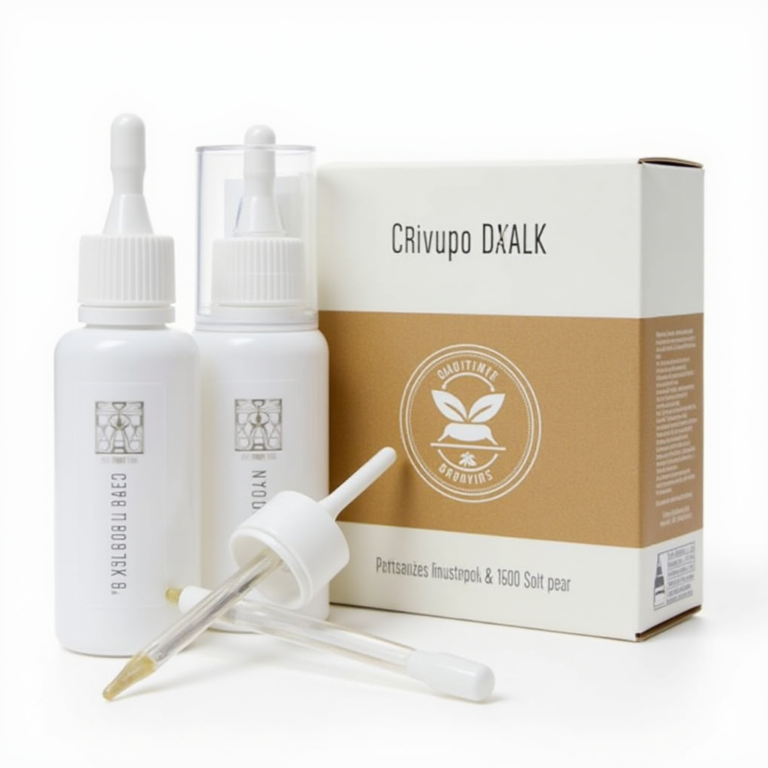
When evaluating dropper bottle 0.5oz(15ml) options, the selection process must move beyond simple capacity. In the context of high-end hair care—specifically scalp serums, concentrated oils, or botanical additives—the 15ml format serves as a precision delivery system. Buyers must categorize their shortlist based on the specific “active” nature of the formula.
Direct Verdict: The Sourcing Framework
For formulas with high essential oil content, glass remains the gold standard to prevent leaching. However, for aqueous-based serums, high-clarity polymers offer significant shipping cost reductions (up to 35% reduction in freight weight). Before requesting a quote, buyers must confirm the Neck Finish (e.g., 18/410 or 20/410) to ensure that third-party closures do not result in “thread-skip” during high-torque automated capping.
Top 3 Failure Triggers in 15ml Sourcing
- Bulb Degradation: Using Nitrile bulbs for formulas containing limonene or high-acid concentrations leads to swelling and failure within 30 days.
- Orifice Mismatch: A 0.5oz bottle paired with a 1.0mm dropper tip will fail to dispense high-viscosity scalp oils, leading to consumer frustration.
- Vacuum Leakage: Inadequate land-seal engagement between the dropper pipette and the bottle neck during air transit (0.8 bar pressure changes).
Que faire ensuite ? Audit your formula’s pH and viscosity. If your viscosity exceeds 2,500 cps, transition from a standard dropper to a treatment pump. Explore the dropper bottle 0.5oz(15ml) options to filter by material type and closure compatibility.
MOQ, lead time, and sample checkpoints for dropper bottle 0.5oz(15ml)
Approvisionnement dropper bottle 0.5oz(15ml) units involves a complex trade-off between inventory carrying costs and per-unit savings. Based on 2023 supplier data, the price variance between a Minimum Order Quantity (MOQ) of 5,000 units and a bulk order of 50,000 units can be as high as 42%.
The Sourcing Timeline and Risk Matrix
| Type de commande | MOQ typique | Délai d'exécution (jours) | Customization Depth | Risk Level |
|---|---|---|---|---|
| Stock Inventory | 1,000 - 3,000 | 7 - 14 | Étiquetage uniquement | Low (Proven Fit) |
| Custom Color/Material | 10,000 – 20,000 | 35 – 50 | PMS Matching, UV Coating | Medium (Batch Variance) |
| New Mold/Tooling | 50,000+ | 75 – 90 | Unique Geometry | High (Tooling Validation) |
Critical Sample Checkpoints
- Compatibility Testing (12 Weeks): Suppliers should provide at least 20-50 samples for “oven aging” tests at 40°C to simulate a 12-month shelf life.
- Decoration Proofs: Ensure the silk-screening or hot-stamping on a 15ml surface area accounts for the curvature; 0.5oz bottles have a limited “flat zone” for branding.
- Torque Consistency: Test the “Break-Torque” of child-resistant closures (CRC). Industry standards suggest a removal torque of 8-12 inch-pounds for 15ml formats.
Que faire ensuite ? Request a “Golden Sample” that is signed by both the supplier QC manager and your procurement lead. This sample serves as the legal benchmark for all future empty shampoo container compatibility and fit disputes.
Specification and sourcing trade-offs for empty shampoo container compatibility and fit
In the bouteille en mousse and shampoo category, “fit” is a mechanical term. The synergy between the dip tube length, the mesh size of the foaming engine, and the bottle’s shoulder geometry determines whether the product remains premium or becomes a “leaker.”
The Diagnostic Playbook: Component Trade-offs
| Fonctionnalité | Standard Choice | Premium Upgrade | Trade-off Impact |
|---|---|---|---|
| Matériau | PET (Clear) | PETG / Heavy Wall | PETG offers better chemical resistance but increases cost by 15-20%. |
| Pump Engine | Internal Spring | External Spring | External springs prevent metal-to-liquid contact, essential for “Clean Beauty” compliance. |
| Neck Finish | 24/410 | 32/410 (Wide) | Wider necks allow for faster filling speeds but increase closure costs. |
| Dip Tube | Standard PE | V-Cut / U-Cut | V-cuts prevent “suction lock” at the bottom of the bottle, ensuring 99% product evacuation. |
Identifying Mismatch Scenarios
A common mistake in empty shampoo container compatibility and fit is pairing a high-viscosity pearlized shampoo with a standard foaming pump. Foaming pumps require a “water-like” viscosity (usually < 100 cps). If your formula is a traditional thick gel, you must bypass the bouteille en mousse category and move toward lotion pumps or disc-top caps.
Conseil de pro : Calculate the Overflow Capacity. A bottle labeled “100ml” often has an overflow of 112ml. If your filling machine has a +/- 2ml variance, you must ensure the “headspace” is sufficient to prevent the pump displacement from causing an overflow during assembly.
Que faire ensuite ? Perform a “Vacuum Leak Test” at 0.05MPa for 5 minutes. If bubbles appear around the neck, the thread pitch of the bottle does not match the closure gasket pressure.
Exemples de produits cartographiés et scénarios d'adéquation
To ground these technical requirements, we examine three specific examples from the catalog that address different empty shampoo container compatibility and fit challenges. These PET (Polyethylene Terephthalate) options are engineered for the hair care market’s rigorous demands.
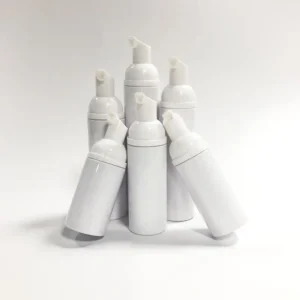
1. The Universal Standard: 30ml-100ml White Pump/White Lid
Le 30ml 60ml 100ML White pump white lid Plastic Foam Bottle is the “safe” procurement choice for travel-sized foaming shampoos.
- Pourquoi cela convient-il ? The PET material provides a high oxygen barrier, which is critical for natural shampoos that use fewer preservatives.
- Best Scenario: Professional salon backbar samples or travel-kit extensions. The white-on-white aesthetic masks any slight formula aeration or “soaping” inside the bottle.
2. The High-Contrast Branding Fit: White/Black Pump Variant
For brands targeting a professional or masculine demographic, the 30ml 60ml 100ML White black pump white lid Plastic Foam Bottle offers a distinct visual break.
- Pourquoi cela convient-il ? The black pump components are often manufactured with higher carbon black content, which can provide slightly better UV resistance for the pump mechanism itself.
- Best Scenario: Charcoal-infused shampoos or scalp detoxifying foams where the “medical-grade” look is desired.
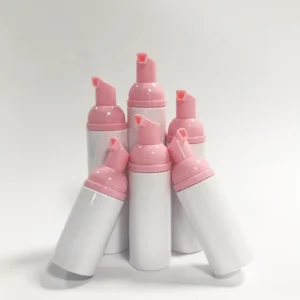
3. The Retail/Boutique Aesthetic: White/Pink Pump Variant
Le 30ml 60ml 100ML White pink pump white lid Plastic Foam Bottle caters to the “giftable” hair care segment.
- Pourquoi cela convient-il ? It uses the same reliable PET 30ml/60ml/100ml footprint but allows for immediate product line differentiation without changing the secondary packaging (boxes) or filling line settings.
- Best Scenario: Color-protecting shampoos or floral-scented mousse products.
Que faire ensuite ? Compare these three variants side-by-side. If your SKU count is high, using the same bottle body with different pump colors (White, Black, Pink) is the most cost-effective way to manage empty shampoo container compatibility and fit while reducing MOQ hurdles across the entire range.
Questions fréquemment posées
Which dropper bottle 0.5oz(15ml) options fit the target application and filling process?
The fit depends on the formula’s viscosity and sensitivity. For scalp oils, glass 15ml dropper bottles with 18/410 neck finishes are ideal. For automated filling, PET or PE 15ml bottles are preferred as they are less prone to breakage on high-speed conveyors. Always verify that the pipette length is within 2mm of the bottle floor to ensure maximum product usage.
What MOQ, lead time, and customization constraints apply to dropper bottle 0.5oz(15ml) sourcing?
Standard MOQs for stock 0.5oz dropper bottles start at 1,000 units with 7-14 day lead times. Custom colors or UV-protected coatings typically require 10,000+ units and 35-50 days. Customization is constrained by the small surface area; complex labels may peel, so silk-screening is often the recommended path for 15ml formats.
When should I browse the dropper bottle 0.5oz(15ml) tag page instead of the foam bottle category?
You should browse the dropper bottle 0.5oz(15ml) options when your product is a high-concentration treatment, such as a scalp serum, beard oil, or essential oil additive. If your product requires aeration or “foaming” at the point of use, the
 English (United States)
  Spanish
  French
  German
  English (UK)
  Japanese
  Korean
  Russian
  Arabic