Comparaison des bouteilles en mousse plastique : quantité minimale de commande, délai de livraison, contrôles par l'acheteur
Procuring the right foaming solution requires balancing a 15% to 25% reduction in liquid consumption against the technical complexities of air-to-liquid ratios and pump mesh precision. A standard plastic foam bottle comparison reveals that while stock PET bottles maintain a 7–12 day lead time, custom-colored components or specific silk-screening can extend production to 35 days. For high-volume procurement, the Minimum Order Quantity (MOQ) typically benchmarks at 5,000 units for standard white or clear variants, escalating to 10,000+ units for custom Pantone matching or specialized dip tube lengths. Compliance with cosmetic-grade standards ensures that 98% of PET-based foamers maintain chemical stability with surfactant-heavy formulations, provided the viscosity remains below 100 cps.
Comment les acheteurs sélectionnent les solutions de bouteilles en mousse
Shortlisting a foam bottle is not merely about aesthetics; it is a technical evaluation of the pump’s internal mesh and the bottle’s thread geometry. Buyers must first determine if their formulation is “foam-ready.” Formulations requiring high concentrations of oils or thickeners often fail in standard foamers, leading to pump seizure or “spitting” rather than a rich lather. Before requesting quotes, procurement teams should confirm the expansion ratio—typically 1:10 to 1:15—to ensure the foam density meets consumer expectations for luxury or clinical applications.
The primary decision drivers for shortlisting include:
- Compatibilité avec les finitions du manche : Most foam pumps utilize a 30mm, 40mm, or 42mm neck. A mismatch of even 0.5mm in thread pitch can lead to 100% leakage rates during transit.
- Material Density: PET (Polyethylene Terephthalate) is the industry standard for its 90% clarity and high impact resistance, though HDPE (High-Density Polyethylene) is preferred for aggressive chemical formulas.
- Dosage Precision: Standard outputs range from 0.4ml to 1.5ml per stroke. For facial cleansers, a 0.8ml output is often the benchmark for user satisfaction.
When evaluating options, it is helpful to reference specialized guides such as the Flacon pompe 40ml pour cosmétique guide to understand how smaller volumes handle different pump mechanisms. Buyers should also verify whether the supplier provides “no-metal contact” pumps if the formulation is sensitive to oxidation.
MOQ, délai de livraison et points de contrôle des échantillons pour les bouteilles en mousse
The procurement timeline for foam bottles is bifurcated between “off-the-shelf” availability and “custom-to-spec” manufacturing. Understanding these variables is critical for preventing launch delays that can cost brands upwards of 12% in projected quarterly revenue.
The Sourcing Matrix: Stock vs. Custom
For brands looking to move quickly, stock options like the 30ml 60ml 100ML Pompe blanche Couvercle blanc Bouteille en mousse plastique Récipient de shampoing vide offer the fastest path to market. However, customization introduces several “lead time multipliers.”
| Order Variable | Standard MOQ | Délai d'exécution (jours) | Critical Buyer Checkpoint |
|---|---|---|---|
| Stock White/Clear PET | 1,000 - 3,000 | 7 - 14 | Check dip tube length for “dead volume” at bottom. |
| Custom Pantone Bottle | 10,000 | 25 - 35 | Verify color consistency across batch lots. |
| Custom Pump Color (e.g., Pink/Black) | 5,000 – 10,000 | 20 – 30 | Ensure spring tension remains consistent with dyes. |
| Silk Screen / Hot Stamping | 5,000 | +7 additional | Request “tape test” for ink adhesion on PET. |
Drapeaux rouges en matière de sourcing
- Inconsistent Spring Tension: If a sample pump feels “mushy” or fails to rebound within 0.5 seconds, it indicates low-grade stainless steel or plastic springs that will fail after 50+ uses.
- Opaque Dip Tubes: While aesthetic, opaque tubes can hide air bubbles or clogs. Transparent PP dip tubes are preferred for quality control.
- Loose Dust Caps: A cap that requires less than 2 lbs of pull force to remove will likely dislodge during automated packing or shipping.
For those considering smaller, more precise applications, the flacon compte-gouttes de 60 ml profile offers a useful comparison in terms of how different closure types (dropper vs. foam pump) handle the same volume of liquid.
Specification and sourcing trade-offs for plastic foam bottle comparison
Dans un plastic foam bottle comparison, the trade-offs usually involve cost versus durability and “perceived value” versus “material weight.” A heavier wall thickness increases the bottle’s “hand feel” but can raise shipping costs by 8–10% due to weight-based freight brackets.
Technical Parameter Comparison
The following framework helps procurement officers weigh the technical specs of 30ml, 60ml, and 100ml foamers:
- Expansion Chamber Volume: Larger chambers (found in 42mm pumps) create a drier, stiffer foam. Smaller chambers (30mm pumps) produce a wetter foam suitable for hand soaps.
- Orifice Size: A 0.5mm orifice is standard, but for high-viscosity “natural” soaps, a 0.7mm orifice may be required to prevent clogging.
- Material Compatibility: PET is susceptible to “stress cracking” when exposed to certain essential oils at concentrations above 3%. In these cases, HDPE or a fluorinated treatment is necessary.
Conseil de pro : Always request a “Vacuum Leak Test” report from the manufacturer. A quality foam bottle should withstand -0.05MPa for 5 minutes without any visible seepage from the neck or pump housing.
When comparing larger formats, referencing the Comparaison avec une pompe blanche de 100 ml : MOQ, délai de livraison, contrôles par l'acheteur guide can provide deeper insights into the performance of 100ml systems specifically.
The “Wrong Spec” Risk Matrix
Choosing the wrong specification can lead to catastrophic failure in the retail environment:
- Wrong Dip Tube Length: If the tube is 2mm too long, it curves and can block the intake. If 2mm too short, 5% of the product is unreachable.
- Low-Grade Mesh: 100-mesh vs. 200-mesh. A lower mesh count produces “bubbly” foam that dissipates in seconds, devaluing the brand.
- Non-Vented Pumps: Can cause the bottle to collapse inward as liquid is dispensed, a common issue in thin-walled PET bottles.
Exemples de produits cartographiés et scénarios d'adéquation
To ground these technical specs, we examine three real-world catalog examples and their specific procurement profiles.
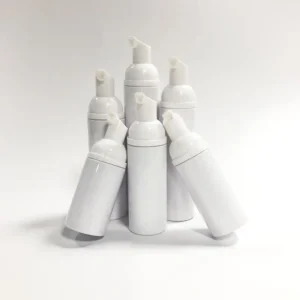
1. The “Clinical Standard”: 30ml/60ml/100ml White Pump/White Lid
Example: 30ml 60ml 100ML White pump white lid Plastic Foam Bottle
- Meilleure adaptation : Medical-grade hand sanitizers, clinical facial cleansers, and travel-sized shampoo.
- Why it works: The all-white aesthetic signals “purity” and “hygiene.” Because white is a standard stock color, the MOQ is often lower (approx. 1,000–3,000 units), and lead times are minimized.
- Procurement Note: This is the safest “entry point” for new brands due to high component availability.
2. The “Premium/Masculine” Edge: White/Black Pump Variant
Example: 30ml 60ml 100ML White black pump white lid Plastic Foam Bottle
- Meilleure adaptation : Men’s beard washes, premium charcoal cleansers, or tattoo aftercare foams.
- Why it works: The black pump provides a visual contrast that supports a higher price point. Black plastic components are generally more resistant to visible staining from dark-colored formulations.
- Procurement Note: Check for “carbon black” compliance if the product is intended for markets with specific recycling sorting requirements.
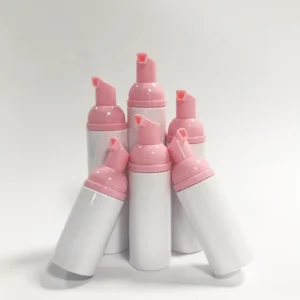
3. The “Beauty & Wellness” Aesthetic: White/Pink Pump Variant
Example: 30ml 60ml 100ML White pink pump white lid Plastic Foam Bottle
- Meilleure adaptation : Feminine hygiene washes, lash cleansers, and gentle baby foams.
- Why it works: The pink pump targets a specific demographic without the cost of a full custom-color bottle run. It allows for “line extensions” where the bottle remains the same, but the pump color changes per SKU.
- Procurement Note: Pink pigments can sometimes be prone to UV fading; ensure the masterbatch includes a UV stabilizer if the product will sit on bright retail shelves.
For those needing a different application style, such as precision oil or serum dispensing, the Flacon compte-gouttes 100ml : MOQ, Délai de livraison, Vérifications de l'acheteur guide serves as an excellent comparison for 100ml volume alternatives.
Questions fréquemment posées
Quelles options de bouteilles en mousse conviennent à l'application cible et au processus de remplissage ?
The best fit depends on formulation viscosity and the desired foam density. For water-thin liquids (shampoos, hand soaps), PET bottles with 30mm or 42mm foam pumps are standard. If your filling process involves high-speed automated lines, ensure the bottle has a “stiff shoulder” design to prevent crushing under the capping head torque. For brands still exploring formats, browsing the full foam bottle category is the best next step to compare neck sizes and pump outputs.
Quelles sont les contraintes en matière de qualité, de délai et de personnalisation qui s'appliquent à l'approvisionnement en bouteilles en mousse ?
Standard white or clear foam bottles usually have an MOQ of 3,000 units with a 14-day lead time. Customizations like Pantone-matched pumps or silk-screening typically push the MOQ to 10,000 units and lead times to 30–35 days. Tooling for a completely unique bottle shape can require 45–60 days. Always factor in an additional 7 days for third-party lab testing if your formulation contains high essential oil content.
Quelles sont les combinaisons de matériaux, de capacités et de fermetures qui conviennent le mieux à la bouteille en mousse ?
The most successful combination is a PET bottle + PP Foam Pump + Overcap. PET provides the clarity consumers desire, while the PP pump offers chemical resistance. For travel sets, 30ml and 60ml capacities are ideal. For household use, 1
 English (United States)
  Spanish
  French
  German
  English (UK)
  Japanese
  Korean
  Russian
  Arabic