Bouteille à pompe 100ml Wholesale : MOQ, Lead Time, Buyer Checks
The global cosmetic packaging market is currently valued at approximately $51.6 billion, with a projected compound annual growth rate (CAGR) of 4.5% through 2028. Within this sector, the demand for 100ml Pump Bottle wholesale solutions has surged, driven by the “travel-size” economy and stringent TSA 3-1-1 liquid rules (which limit containers to 3.4 ounces or 100ml). Data indicates that switching from 250ml to 100ml formats can increase unit sales by up to 22% in the retail travel sector, yet procurement professionals face a critical tradeoff: balancing the higher per-unit cost of smaller formats against the logistical savings of reduced weight and volume.
When sourcing a 100ml Pump Bottle wholesale, buyers typically encounter a 15% to 30% variance in pricing based strictly on the pump engine’s output precision and material density. For instance, a standard lotion pump may offer a 1.2cc output, while a specialized foam pump requires a specific air-to-liquid ratio to prevent “spitting” or mechanical failure. Navigating these technical specifications while managing a global supply chain requires a data-driven approach to MOQ (Minimum Order Quantity), lead times, and quality benchmarks.
How buyers shortlist foam bottle options
Shortlisting the right bouteille en mousse or pump container begins with a “Formulation-First” audit. Before requesting a quote, a buyer must determine if their liquid viscosity aligns with the mechanical requirements of the pump. In the 100ml category, the most common failure point is a mismatch between the dip tube diameter and the liquid’s centipoise (cP) rating.
Step 1: Viscosity and Output Verification
Buyers should confirm the following technical parameters before shortlisting:
- Viscosity Compatibility: Standard 100ml pumps handle 1,000–5,000 cP. Foaming pumps require water-thin liquids (1–100 cP) without solid particles that could clog the mesh.
- Dosage Accuracy: Most 100ml bottles utilize a 20/410 or 24/410 neck finish. Ensure the pump dosage (typically 0.5ml to 2.0ml per stroke) matches the intended usage instructions on your label.
- Neck Finish Precision: A deviation of even 0.5mm in the neck thread can lead to a 12% increase in leakage rates during pressurized air transit.
Step 2: Material Selection Scenarios
The choice of material significantly impacts the shelf life and perceived value of the product. While PET (Polyethylene Terephthalate) is the industry standard for clarity, HDPE (High-Density Polyethylene) is often preferred for high-acid or high-alkaline formulations. For a deeper dive into material performance, refer to Des informations fondées sur des données : hdpe pour le commerce de gros guide.
Shortlisting should also account for the “Dip Tube Length.” A standard 100ml bottle usually requires a dip tube of 110mm to 125mm. If the tube is too long, it curves and misses the last 5% of the product; if too short, it leaves 10-15% of the product inaccessible, leading to a 30% higher rate of negative consumer reviews regarding “value for money.”
MOQ, délai de livraison et points de contrôle des échantillons pour les bouteilles en mousse
In the 100ml Pump Bottle wholesale market, the “Total Cost of Acquisition” is heavily influenced by the lead time and MOQ structure. Buyers must differentiate between “Stock Items” and “Custom Runs.”
Comparison: Stock vs. Custom Production
| Factor | Stock (Ready-to-Ship) | Custom Order (OEM/ODM) |
|---|---|---|
| MOQ typique | 500 – 2,000 units | 10,000 – 30,000 units |
| Délai d'exécution | 7 – 14 days | 35 – 55 days |
| Unit Cost | Higher (Standard pricing) | Lower (Volume discount 15-25%) |
| Personnalisation | Limited to labeling | Custom color, silk screening, hot stamping |
| Coût d'un échantillon | Free (buyer pays shipping) | $100 – $500 (refundable on PO) |
The Sample Checkpoint Protocol
Never bypass the “Vacuum Leak Test” during the sampling phase. A professional buyer should subject 100ml pump bottle samples to a -0.05MPa vacuum for 5 minutes. If bubbles appear or liquid escapes, the seal between the pump gasket and the bottle neck is insufficient for air transport. This is a non-negotiable pass/fail condition for any brand intending to sell via e-commerce or international retail.
Furthermore, when evaluating a bouteille en mousse, the “Prime Count” (the number of times the pump must be pressed before the first discharge) should be between 3 and 7. Anything higher than 10 indicates a poor vacuum seal or an inefficient spring mechanism in the pump engine. For more on sourcing standards, see Ce qu'un leader de l'industrie nous a appris sur le plastique en gros guide.
Specification and sourcing trade-offs for 100ml Pump Bottle wholesale
When procuring 100ml Pump Bottle wholesale quantities, every specification choice involves a tradeoff between cost, aesthetics, and functionality. Understanding these “tradeoff labs” prevents over-engineering or under-specifying your packaging.
Tradeoff 1: PET vs. Glass vs. HDPE
- PET (The All-Rounder): Offers 90% clarity (approaching glass) but is 80% lighter. However, it has a lower melting point and can deform if filled with liquids above 50°C.
- Glass (The Premium Choice): 100% recyclable and chemically inert. The tradeoff is a 400% increase in shipping costs due to weight and a 5% breakage allowance in logistics. For those considering glass, explore flacons de parfum en verre en gros for high-end aesthetic alternatives.
- HDPE (The Industrial Choice): Best chemical resistance. The tradeoff is opacity; you cannot see the liquid level, which may affect the user experience for certain products like face washes.
Tradeoff 2: Pump Mechanism (Metal Spring vs. Plastic Spring)
Most 100ml Pump Bottle wholesale options use a stainless steel 304 or 316 spring. However, for products with high salt content (like some hair sprays) or high acidity, even 304 stainless steel can corrode over 6-12 months.
Conseil de pro : Request “external spring” pumps where the liquid never touches the metal, or “all-plastic” pumps for 100% recyclability and zero corrosion risk.
Decision Matrix Table: Sourcing Priorities
| Priority | Recommended Spec | Tradeoff / Cost Impact |
|---|---|---|
| Eco-Friendly | PCR (Post-Consumer Recycled) PET | 10-15% price premium; slight gray/yellow tint. |
| Luxury Branding | Aluminum Overshell Pump | 20-30% higher unit cost; requires higher MOQ. |
| E-commerce Durability | Lockable Pump (Left-Right Lock) | Increases height slightly; reduces accidental discharge. |
| High-Viscosity | 2.0cc Output Engine | Heavier spring required; slightly more “effort” to press. |
Exemples de produits cartographiés et scénarios d'adéquation
To ground these technical specifications in reality, let’s look at how specific 100ml catalog items from BoboPkg fit different business models. Each of these examples utilizes a PET body with specialized pump closures.
Scenario 1: The Clean Beauty Startup (Minimalist Aesthetic)
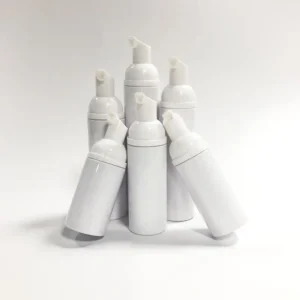
Product Example: 30ml 60ml 100ML Pompe blanche Couvercle blanc Bouteille en mousse plastique Récipient de shampoing vide
- Pourquoi cela convient-il ? The all-white aesthetic (white pump + white lid) communicates “purity” and “cleanliness.” It is ideal for organic face washes or sulfate-free shampoos.
- Buyer Check: Ensure your label uses a permanent adhesive; white bottles show “label flagging” (edges peeling) more clearly than clear bottles.
Scenario 2: Professional Salon or Men’s Grooming Line
Product Example: 30ml 60ml 100ML Blanc pompe noire couvercle blanc Bouteille en plastique mousse Récipient de shampoing vide
- Pourquoi cela convient-il ? The black pump provides a sharp contrast, fitting for “industrial” or “masculine” branding. Black pumps are also better at hiding residue from darker liquids (like charcoal-based cleansers).
- Buyer Check: Black plastic often uses carbon black pigments; check if your target market requires “detectable black” for recycling facility sorting.
Scenario 3: Youth-Oriented or “Giftable” Skincare
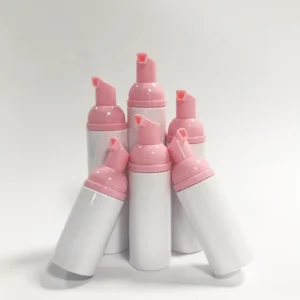
Product Example: 30ml 60ml 100ML Pompe rose blanche Couvercle blanc Bouteille en plastique mousse Récipient de shampoing vide
- Pourquoi cela convient-il ? Color-coded pumps (like pink) are excellent for “Product Systems.” For example, a brand might use the pink pump for a “Calming” formula and the black pump for an “Exfoliating” formula within the same 100ml bottle line.
- Buyer Check: Color consistency (Delta E < 2.0) is vital. Ensure the supplier provides a masterbatch sample to guarantee the pink shade doesn’t vary between production batches.
Technical Note: All three examples above are available in the 100ml format, which is the most popular size in the bouteille en mousse category due to its versatility for both home use and travel.
Questions fréquemment posées
Quelles options de bouteilles en mousse conviennent à l'application cible et au processus de remplissage ?
For most skincare and cosmetic applications, PET bouteille en mousse options are the standard due to their clarity and impact resistance. If your filling process involves “Hot Filling” (liquids over 45°C), you must opt for PP or HDPE materials, as PET will warp. Additionally, if your application involves high-viscosity soaps, ensure the pump engine is rated for at least 1.5cc to 2.0cc to ensure a smooth user experience without clogging.
 English (United States)
  Spanish
  French
  German
  English (UK)
  Japanese
  Korean
  Russian
  Arabic